

Actual Vote in Texas
Access poll tapes after election night
Information current as of October 2026
This page explains how to use the Actual Vote app in Texas for the next election. New to Actual Vote? Start here to learn what it is and why it matters.
Texas is a different kind of state for Actual Vote. Nothing is posted at the polling place on election night — so you can’t drive a circuit and record tapes the way you can in some states. But Texas makes up for it with the strongest after-the-election access in the country: once your county finishes its unofficial count, every precinct’s poll tape becomes public and you can go inspect and record it at the elections office. The Texas play is the week after the election, not election night.
Your participation is powerful: you become part of a nationwide team whose recordings get compared, tape-by-tape, against the officially reported results. That matters because vote reporting is vulnerable to error and fraud — and an independent record kept outside the government’s chain of custodyThe documented sequence of who holds election records and when — the path results travel from the precinct to the official tally. is exactly what catches a reporting-layer mistake. In Texas there’s a nice bonus: when a precinct tape and the central count disagree, state procedure makes the precinct tape the official result — so the very thing you record is the legal anchor.
We haven’t published an Actual Vote analysis from Texas yet — but see what a team achieved in the 2024 North Carolina primary to picture what’s possible here. And the process is legal and next-to-impossible to abuse for partisan gain: everything on a poll tape is already public, and the comparison only checks whether totals were reported faithfully.
Poll closing time in Texas: 7 p.m. Anyone still in line at closing time is entitled to vote, so the closing procedure — and the tape — can run later.
This information was compiled using AI-assisted internet research along with some calls to election offices and word-of-mouth tips. It reflects America Counts’s best knowledge of how to access poll tapes in Texas as of October 2026, but it cannot be guaranteed 100% accurate. The best way to be sure about accessing poll tapes in your area is to call your local elections office and ask — see below for ready-to-use scripts.
If your experience or knowledge of poll-tape procedure in Texas is different from what we show here, please contact us and let us know — we update these pages as we learn more.
Your ways to participate in Texas
See how the six ways to help compare →
- 1
Record posted tapes at polling placesNot available in TexasTexas does not post tapes on election night: the signed copies are sealed at close, and a state law (§ 62.013) makes an unauthorized posting by an election officer a misdemeanor (whether it applies after the polls close is untested). There is nothing posted at the polling place to record.
- 2
Be there at the close or observe the countNot available in TexasThe public can’t watch the close in Texas; tapes become available after election night (use cases 5 and 6).
- 3
Record early-voting tapes
When early voting ends, Texas machines print only a count of ballots scanned, not votes, and central-count reports made before election day can’t include vote counts (SB 2217, 2025). Early votes are counted at the county’s central counting station. Once the unofficial count is done, the precinct returns become public records you can inspect and video-record at the elections office (use case 5). Call your county elections office ahead of time and ask where and when the early-voting tapes will be printed, and whether you may observe and video-record them. If they don’t have a plan to show them, you can politely ask them to display the tapes.
See a detailed example of recording early-voting tapes, based on Cobb County, Georgia.
- 4
Become a poll worker or observer
Texas’s presiding judge and alternate presiding judge are appointed from lists the two major parties submit (one from each party in county elections), and at the close they print and sign the results tape. Poll watchers, appointed by parties and candidates, can stay through the close, inspect the returns and sign the tape. But Texas bars recording images within 100 feet of a voting station except as part of an election officer’s official duties (§ 61.014). The Secretary of State defines a voting station as the area where the voter marks the ballot, and says election officials may use devices only to conduct official duties (Advisory 2026-13). The ban has no time limit, so it most likely still applies while the tape prints after polls close, and watchers must disable recording devices. Don’t film the tape at the polling place, even with everyone’s agreement, unless your county makes video-recording the signed tape part of your official duties in writing. Watchers can copy the totals by hand. The presiding judge’s own copy (Envelope 3) becomes a public record once its delivery is complete (§ 66.057(c)), so it can be video-recorded away from the polling place afterwards; check with your county first.
See more details about Actual Vote for poll workers or observers.
- 5
Inspect and record poll tapes at your county elections office
This is the main way to get tapes in Texas. Texas doesn’t post tapes on election night, but it has the best after-the-fact access in the country. Once your county finishes its unofficial count — generally election night — each precinct’s results tape becomes public and you can inspect it at the elections office during regular business hours, as a matter of right (no formal request needed). Bring the Actual Vote app the week after the election and record the tapes there. Records are kept for 22 months, so there’s no rush. From September 2026, the county’s central system must also be able to produce results by polling place (§ 127.133), so ask for that report too.
Phone/email script — arrange to inspect & record tapes at your county office
Hi, my name is [name]. I’m a user of Actual Vote, an app from America Counts, a non-partisan election transparency organization — volunteers record poll tapes and compare them to the official results as an independent double-check.
My understanding is that under the Texas Election Code, once the county has completed its unofficial count, the precinct results tapes are public information (§ 66.057) and may be inspected at the elections office during regular business hours (§ 1.012). I’d like to come in and view and video-record the results tapes for [all precincts / the following precincts: ____] from the [date] election. When would be a good time, and is there anything I should bring or any rule I should follow?Inspection is a right, not a favor — but offices set "reasonable rules" (§ 1.012(b)) on timing, so a friendly heads-up call makes the visit smooth. Records are kept 22 months (§ 66.058), so you have time. If something differs from this page, tell us and we’ll verify and fix it.
See a detailed example of how to do this.
- 6
Request electronic copies, ballot images, or cast vote records
Texas also gives you an electronic copy of election records within 15 days for at most $50, and makes cast vote records and ballot images public the day after the final canvass — Texas is one of the best states in the country for this kind of data. Convenient for covering many precincts, though it’s later in the chain of custody than recording the tape in person.
Public-records request — Texas tapes, ballot images, or cast vote records
To: [County] County Elections Office
Re: Public Information Act request — precinct results tapes & cast vote records
Hello, and thank you for your work. Under the Texas Public Information Act and Texas Election Code § 1.012, I request electronic copies of the following from the [date] election:
• The precinct results tapes (the printed totals from each voting-system device) for [all precincts / the following precincts: ____];
• If available, the cast vote records / ballot images for the same (public the day after the final canvass under § 1.012(f)).
I understand electronic copies of election records are provided within 15 days for a fee not to exceed $50 (§ 1.012(e)). I’m requesting these for Actual Vote, an app from America Counts, a non-partisan election transparency organization that compares reported vote totals to official results as an independent double-check (see an example analysis). Please let me know the format, fee, and timeline. Thank you. — [name], [contact]Texas’s 15-day / $50 electronic-copy rule and day-after-canvass CVR access make it one of the best states for covering many precincts without leaving home.
See a detailed example of how to do this.
Live near a state line? Consider crossing it.
Texas makes election-night recording hard — but these neighbors post a results tape right on the outside of the polling place: Louisiana, New Mexico or Oklahoma. If you live near the border, a short drive across it can be the highest-value Actual Vote move of the night. Honest caveat: a tape you record there verifies that state’s precinct, not your own — it complements your in-state options, it doesn’t replace them.
See a detailed example of how to make a plan to visit polling places on election night based in Broward County, Florida.
Heads up: Texas restricts on-site recording of the tape. Don’t record where it isn’t allowed — rely on official results and the post-election records route instead.
Example Actual Vote Recordings
We don’t have any recordings from Texas yet — you could be the first! Here are some example poll tape videos by Actual Vote users in other states, all taken during scheduled visits to an elections office. America Counts compares the vote totals on each poll tape video to the official results to double-check the accuracy of the vote reporting. See this report from North Carolina in 2022 for an example.
-
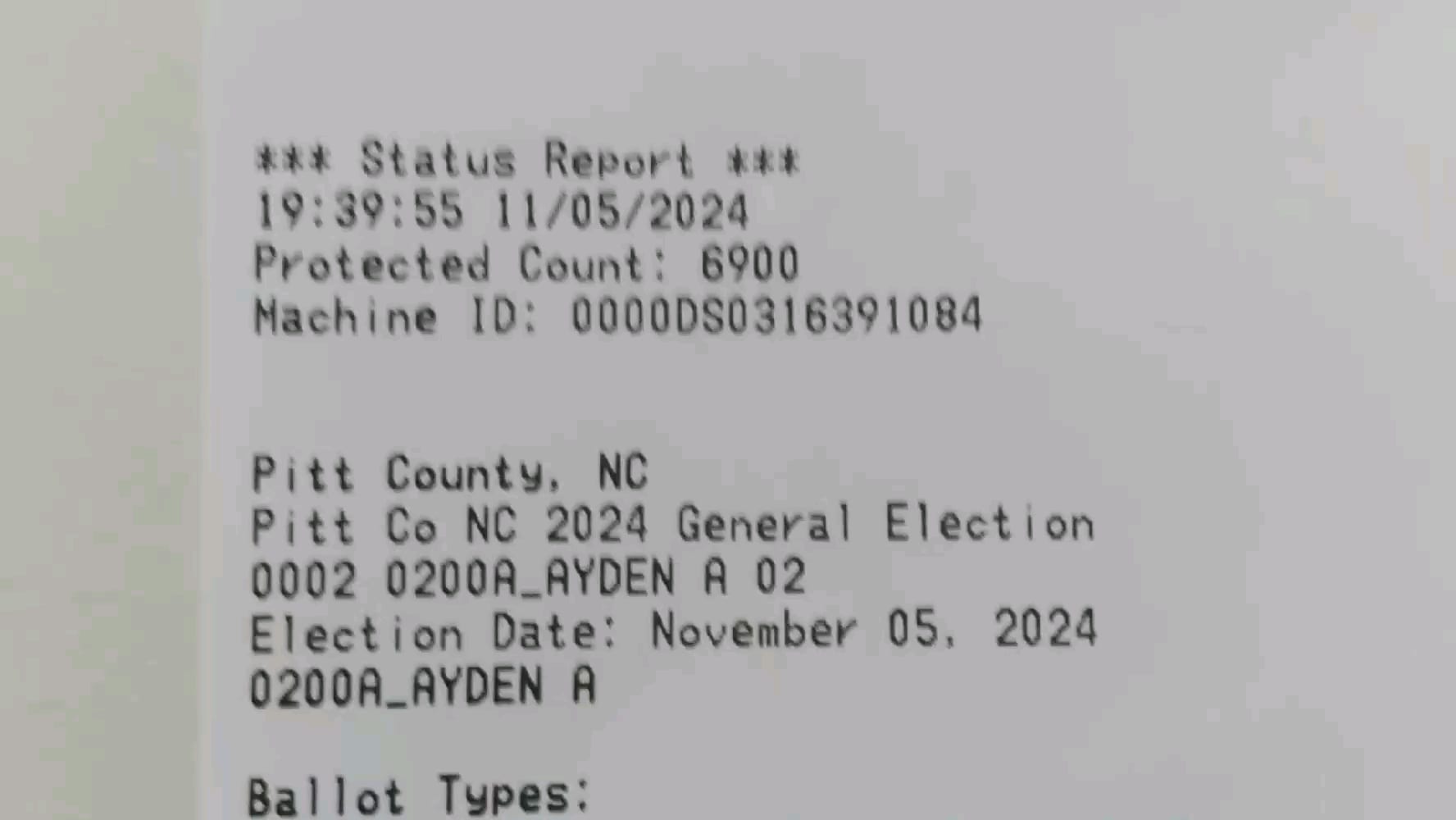 Pitt County, North Carolina November 6, 2024
 -
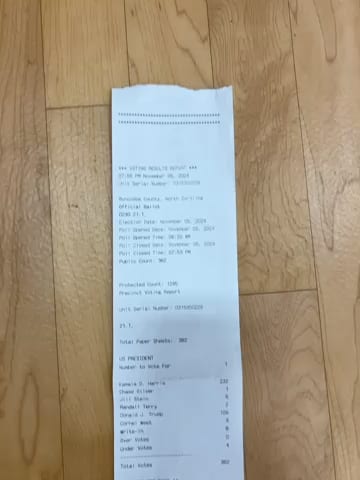 Buncombe County, North Carolina November 6, 2024
 -
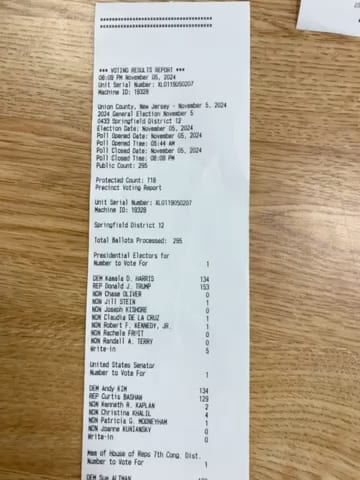 Union County, New Jersey November 6, 2024
Recordings live in the public Actual Vote Video Archive.
How we know this — and how you can check it
We start from Texas’s own primary sources — the Election Code and the Secretary of State’s official procedures — and read the exact provisions rather than relying on summaries. Two things define Texas: nothing is posted on election night, and almost everything becomes available right afterward.
Election night: nothing posted, by design. Both copies of each device’s results tape are sealed at the close, and § 62.013 makes an unauthorized posting by an election officer a misdemeanor — so counties have an affirmative reason not to post. Credentialed poll watchers may observe and inspect the returns, but § 33.006(b)(6) requires them to disable any recording device.
The week after: the strongest access in the country. Under § 66.057(a), the sealed results tape becomes public information once the county completes its unofficial tabulation of that precinct — generally election night. § 1.012(a) then makes public election records available "during the regular business hours of the record’s custodian," as a matter of right (no formal request needed), with records preserved 22 months (§ 66.058). On top of in-person inspection, § 1.012(e) gives you an electronic copy within 15 days for at most $50, and § 1.012(f) (added 2023) makes cast vote records and ballot images public the day after the final canvass. And when a precinct tape and the central count disagree, the Secretary of State’s reconciliation procedure makes the precinct tape the official result — the tape you record is the legal anchor.
Why we’re confident this is current: every load-bearing provision (§§ 1.012, 33.056, 62.013, 65.015, 66.057) was verified verbatim against the canonical statutes.capitol.texas.gov text. Recent changes are folded in: SB 827 (2025) expanded the post-election hand-count audit, and HB 3909 (2025) tightened the in-room wireless-device ban. You can run the same check: read § 66.057 and § 1.012, then call your county elections office. Found something different? Help us verify it.
Find your county's election website
County sites carry the elections office address, hours, and contacts you’ll need for inspection. Links rot — if one 404s, search "[your county], Texas elections".
- Anderson County
- Andrews County
- Angelina County
- Aransas County
- Archer County
- Armstrong County
- Atascosa County
- Austin County
- Bailey County
- Bandera County
- Bastrop County
- Baylor County
- Bee County
- Bell County
- Bexar County
- Blanco County
- Borden County
- Bosque County
- Bowie County
- Brazoria County
- Brazos County
- Brewster County
- Briscoe County
- Brooks County
- Brown County
- Burleson County
- Burnet County
- Caldwell County
- Calhoun County
- Callahan County
- Cameron County
- Camp County
- Carson County
- Cass County
- Castro County
- Chambers County
- Cherokee County
- Childress County
- Clay County
- Cochran County
- Coke County
- Coleman County
- Collin County
- Collingsworth County
- Colorado County
- Comal County
- Comanche County
- Concho County
- Cooke County
- Coryell County
- Cottle County
- Crane County
- Crockett County
- Crosby County
- Culberson County
- Dallam County
- Dallas County
- Dawson County
- Deaf Smith County
- Delta County
- Denton County
- DeWitt County
- Dickens County
- Dimmit County
- Donley County
- Duval County
- Eastland County
- Ector County
- Edwards County
- Ellis County
- El Paso County
- Erath County
- Falls County
- Fannin County
- Fayette County
- Fisher County
- Floyd County
- Foard County
- Fort Bend County
- Franklin County
- Freestone County
- Frio County
- Gaines County
- Galveston County
- Garza County
- Gillespie County
- Glasscock County
- Goliad County
- Gonzales County
- Gray County
- Grayson County
- Gregg County
- Grimes County
- Guadalupe County
- Hale County
- Hall County
- Hamilton County
- Hansford County
- Hardeman County
- Hardin County
- Harris County
- Harrison County
- Hartley County
- Haskell County
- Hays County
- Hemphill County
- Henderson County
- Hidalgo County
- Hill County
- Hockley County
- Hood County
- Hopkins County
- Houston County
- Howard County
- Hudspeth County
- Hunt County
- Hutchinson County
- Irion County
- Jack County
- Jackson County
- Jasper County
- Jeff Davis County
- Jefferson County
- Jim Hogg County
- Jim Wells County
- Johnson County
- Jones County
- Karnes County
- Kaufman County
- Kendall County
- Kenedy County
- Kent County
- Kerr County
- Kimble County
- King County
- Kinney County
- Kleberg County
- Knox County
- Lamar County
- Lamb County
- Lampasas County
- La Salle County
- Lavaca County
- Lee County
- Leon County
- Liberty County
- Limestone County
- Lipscomb County
- Live Oak County
- Llano County
- Loving County
- Lubbock County
- Lynn County
- McCulloch County
- McLennan County
- McMullen County
- Madison County
- Marion County
- Martin County
- Mason County
- Matagorda County
- Maverick County
- Medina County
- Menard County
- Midland County
- Milam County
- Mills County
- Mitchell County
- Montague County
- Montgomery County
- Moore County
- Morris County
- Motley County
- Nacogdoches County
- Navarro County
- Newton County
- Nolan County
- Nueces County
- Ochiltree County
- Oldham County
- Orange County
- Palo Pinto County
- Panola County
- Parker County
- Parmer County
- Pecos County
- Polk County
- Potter County
- Presidio County
- Rains County
- Randall County
- Reagan County
- Real County
- Red River County
- Reeves County
- Refugio County
- Roberts County
- Robertson County
- Rockwall County
- Runnels County
- Rusk County
- Sabine County
- San Augustine County
- San Jacinto County
- San Patricio County
- San Saba County
- Schleicher County
- Scurry County
- Shackelford County
- Shelby County
- Sherman County
- Smith County
- Somervell County
- Starr County
- Stephens County
- Sterling County
- Stonewall County
- Sutton County
- Swisher County
- Tarrant County
- Taylor County
- Terrell County
- Terry County
- Throckmorton County
- Titus County
- Tom Green County
- Travis County
- Trinity County
- Tyler County
- Upshur County
- Upton County
- Uvalde County
- Val Verde County
- Van Zandt County
- Victoria County
- Walker County
- Waller County
- Ward County
- Washington County
- Webb County
- Wharton County
- Wheeler County
- Wichita County
- Wilbarger County
- Willacy County
- Williamson County
- Wilson County
- Winkler County
- Wise County
- Wood County
- Yoakum County
- Young County
- Zapata County
- Zavala County
Ready to help?
Join the nationwide team independently double-checking how votes are reported — starting in Texas.