
Step 1 of 7
How Actual Vote Works
A practical walkthrough of how the Actual Vote system works.
Actual Vote is our app-based system for double-checking vote reporting. Here’s how it works.
From voting to tabulation
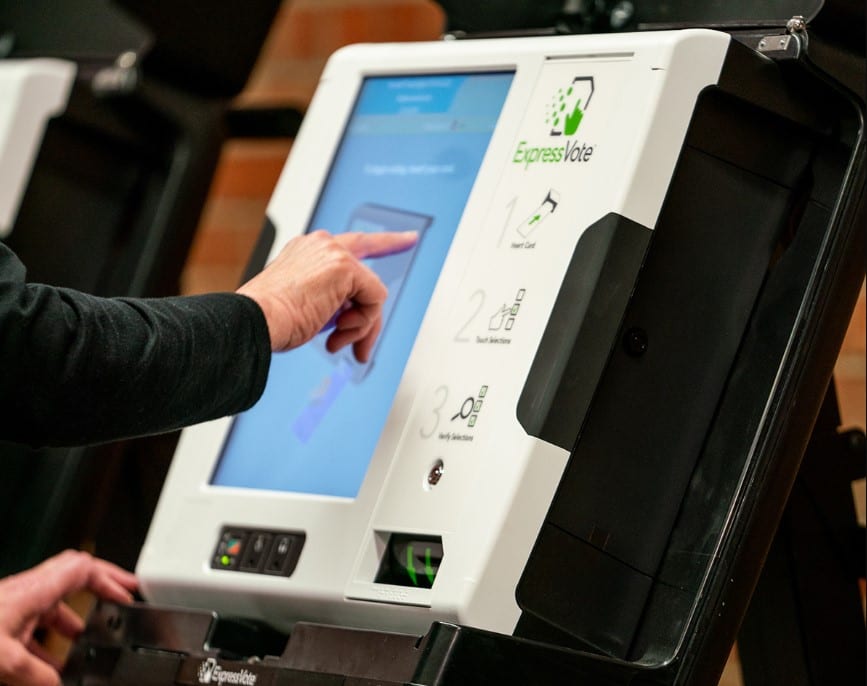
On election day, voters show up at their polling place to vote on a voting machine, like this ExpressVote machine from Election Systems & Software. (Other voters will have already cast their ballots through early voting or absentee voting.)
Once voting is over, each precinct counts all the votes that have come in from each voting method. This is called tabulating the votes.
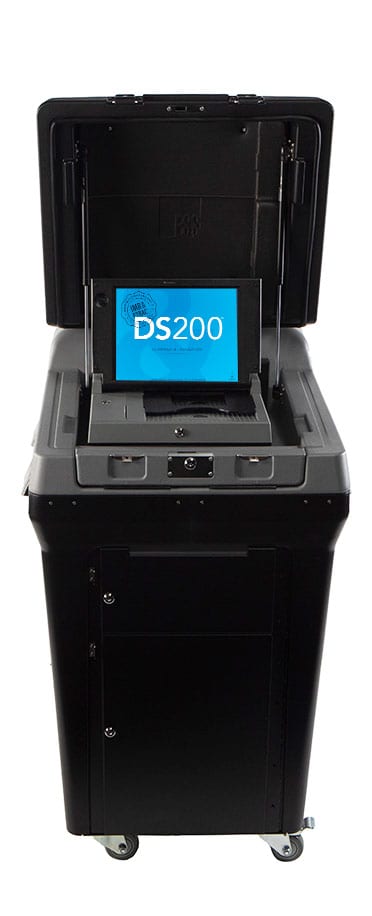
Almost all precincts in the US use tabulating machines to do this, like this DS200 machine made by Election Systems & Software.
Poll tapes: the key artifact
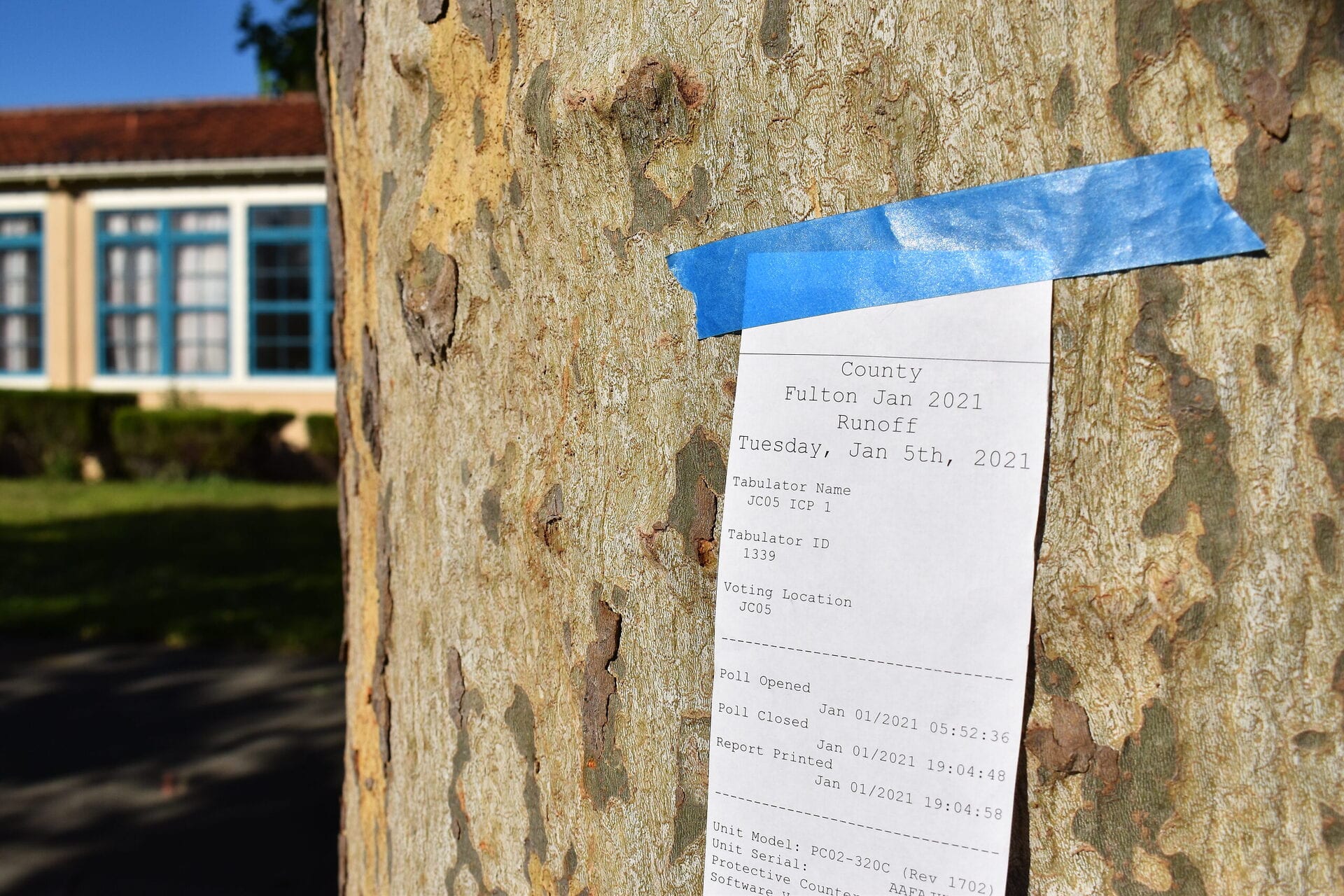
A tabulating machine outputs its results in whichever formats are required by local law — sometimes a USB drive with electronic results, and sometimes by printing poll tapes (also called results tapes or election tapes). A poll tape is a long strip of paper showing the tabulated results:
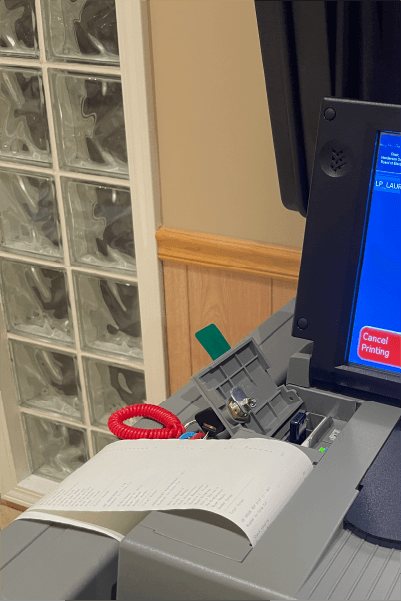
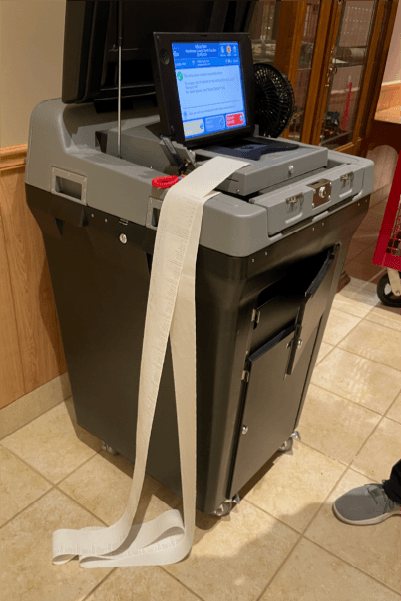
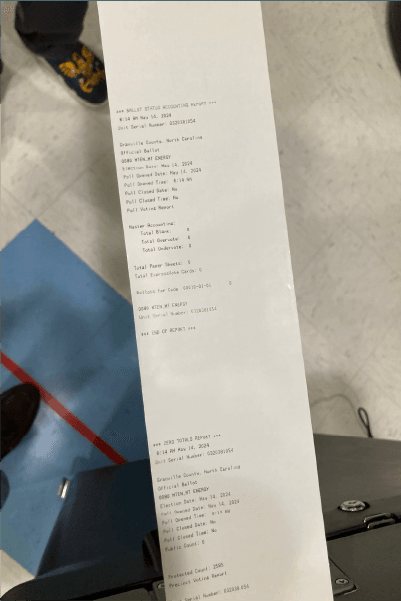
Poll tapes can look different depending on the county, voting equipment, and election, but they all contain the same basic information: the vote totals for each race and candidate at that precinct. These are sometimes called results tapes, since they show the results of the tabulation.
A concrete example: Crow County
Let’s use a fictional place called “Crow County” to see how this works.
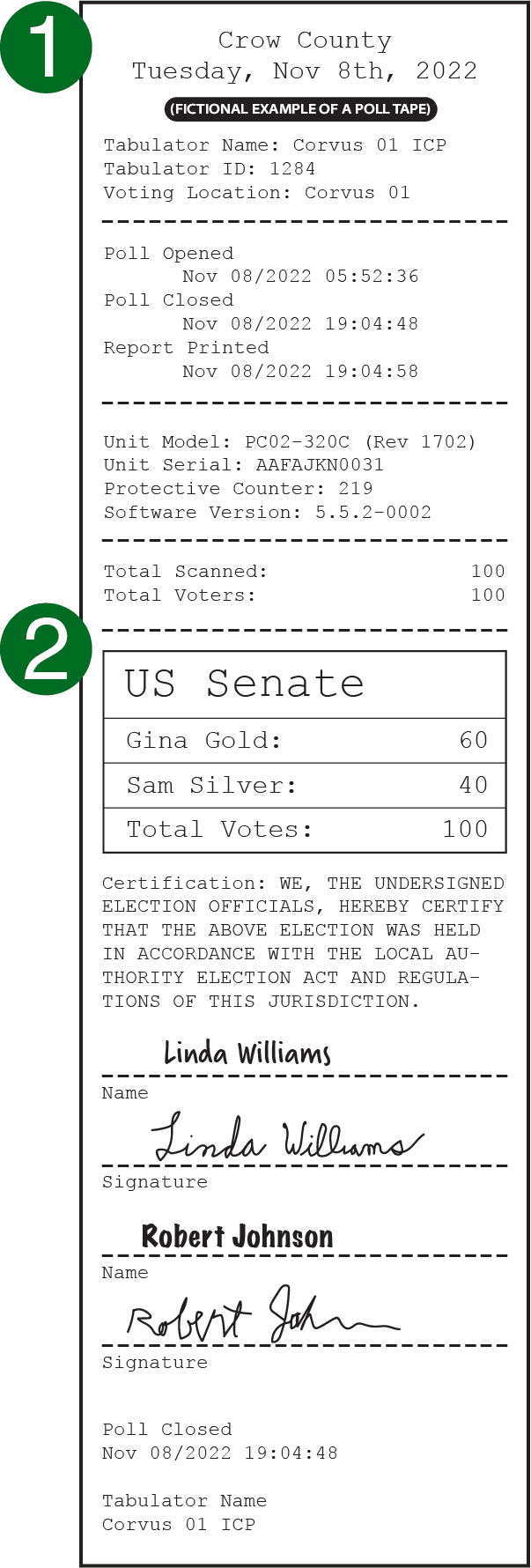
Here’s what a poll tape from Crow County looks like:
① The Header Section. This poll tape is from Crow County’s November 2022 Midterm election. The voting location is Corvus 01, which corresponds to election day votes from the Corvus Hill Community Center precinct.
There are three other poll tapes from this election — one from each of Crow County’s other in-person voting locations. (For simplicity, we’ll say there was no absentee or early voting in this election. In real elections, there would be poll tapes for those as well.)
② The Vote Total Section. This is the most important part. It shows that the only race in this precinct was US Senate: Gina Gold received 60 election day votes, and Sam Silver received 40.
Vote reporting: where things can go wrong
Once all four precincts in Crow County have tabulated their votes and forwarded the results to the county elections office, the results are combined into official countywide totals and released to the public. This process is called vote reporting.
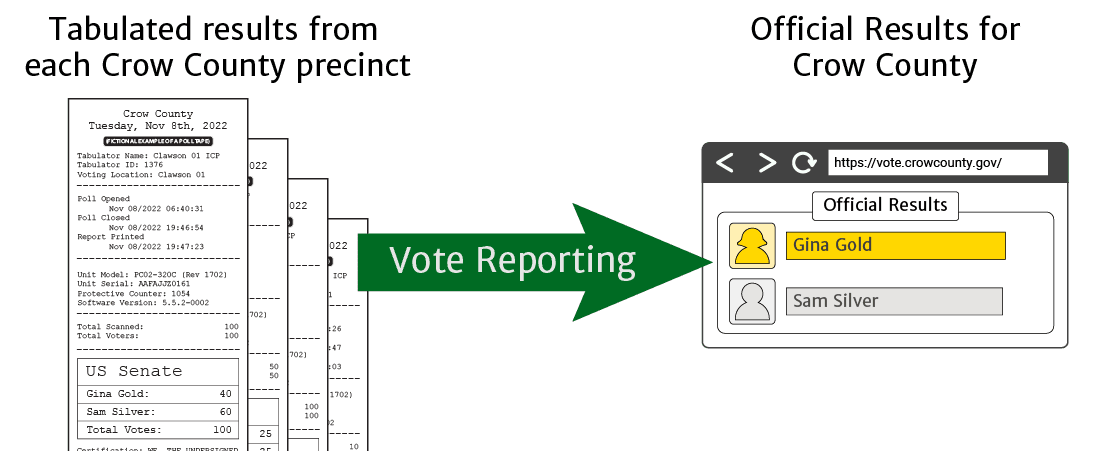
The official results should be completely consistent with the vote totals on the poll tapes, since they’re just different views of the same underlying data.
Unfortunately, vote reporting in the US is vulnerable to error and fraud. The process of aggregating local-level numbers into official countywide and statewide results — often involving electronic transfers, manual data entry, and complex software — creates opportunities for things to go wrong, whether by accident or by design.
This is where you come in
If we could somehow compare the vote totals on the poll tapes with the official results, we could check whether they’re consistent. If there were error or fraud in the vote reporting, this comparison could detect it.
With the Actual Vote app, you can help America Counts do exactly that — double-check the vote reporting in your area. This process is called auditing the vote reporting, and it’s a powerful way to help strengthen democracy.
Here’s how it works: with the Actual Vote app, you take video-recordings of poll tapes, like this:
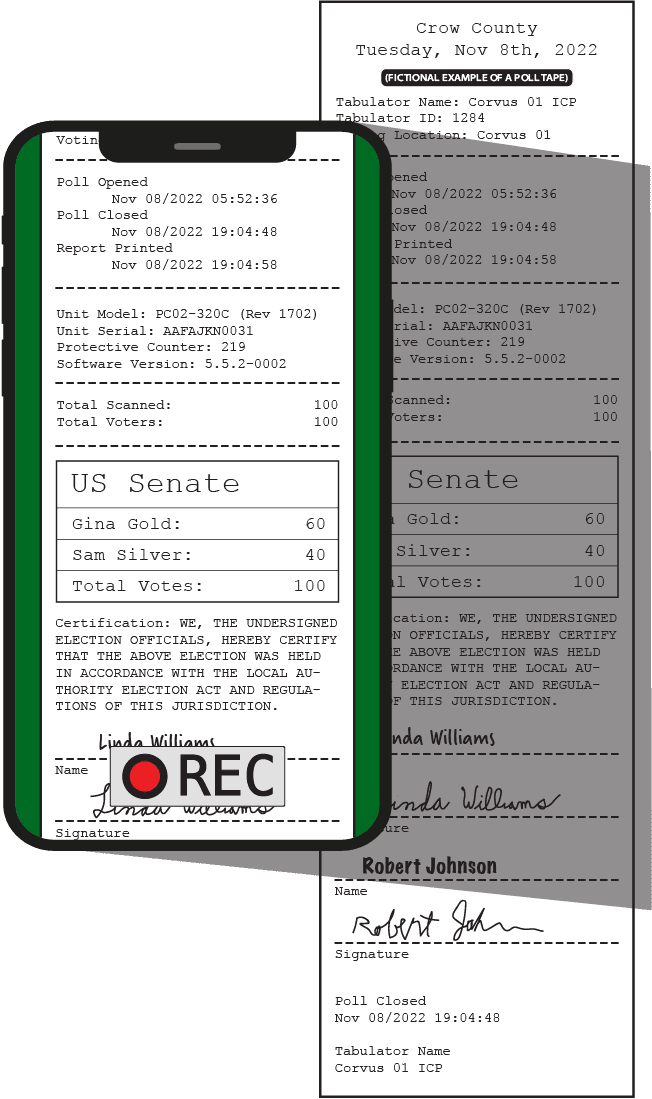
Your videos are automatically uploaded to America Counts, preserving the information on the poll tapes. Other users from your area and around the country do the same thing.
America Counts then uses our expert knowledge and software to compare the numbers on your poll tape videos to the official results:
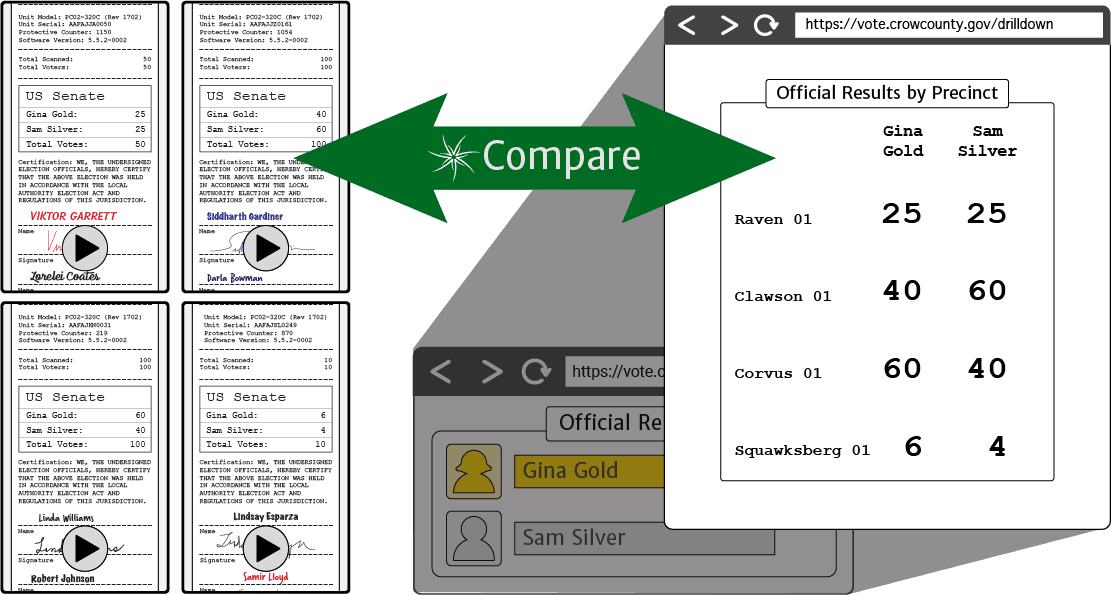
Most of the time, we find that all votes were reported correctly — and your effort helps improve election transparency by providing independent confirmation of that fact.
Behind the scenes, much of that comparison is now handled by a tool we built called Actual Vote Assist. It reads the numbers off each poll-tape video automatically and checks them against the official results, while still handing anything it can’t read clearly to a person to review. That’s what lets a small team keep up with thousands of recordings from across the country — without ever having to take the software’s word for a number, since the original videos stay public for anyone to double-check.
But occasionally, we uncover a discrepancy in vote reporting. When that happens, we work with election administrators to find an explanation. If we find a discrepancy that we can’t explain even after investigation — what we call an apparent discrepancy — Actual Vote recordings can serve as evidence in a legal challenge to the official results.
To see the full results of our work, we publish detailed reports of our findings — for example, the report from North Carolina’s 2024 Primary Election.
One thing to watch for: zero tapes
Tabulating machines don’t just print results tapes. They also print something called a zero tape before voting begins. A zero tape proves that all vote total fields on the machine start at zero — confirming that no stale votes from a previous election are stored on it. Zero tapes look very similar to results tapes (same format, same layout), but every vote total on them is zero.
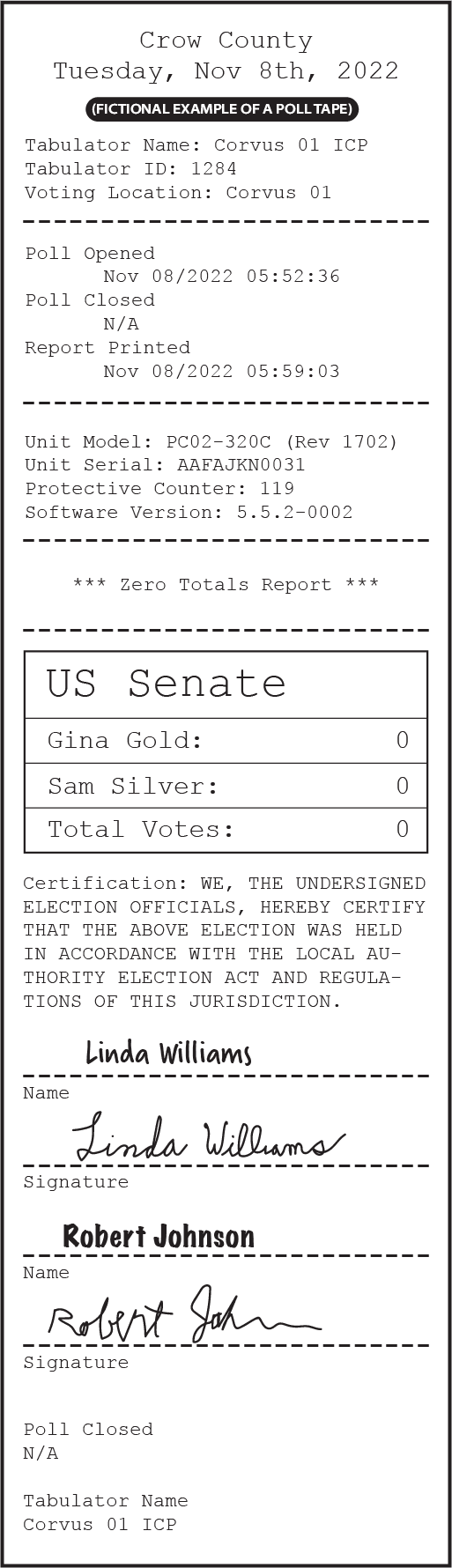
Example of a zero tape — notice all the vote totals are zero.
Zero tapes serve an important security function, and recording them with Actual Vote can add an extra layer of verification. But for the purposes of auditing vote reporting, what we need are results tapes — the ones printed after voting is over that show the actual vote totals. If you record only zero tapes (which can happen if, for example, poll workers accidentally post zero tapes instead of results tapes), there are no vote totals for us to compare against the official results. When you’re out recording, make sure you’re looking at tapes with actual vote numbers on them — not all zeros.