
Step 3 of 7
The Benefits of Actual Vote
What participating produces, for you and for everyone.
By video-recording poll tapes with the Actual Vote app, you generate real benefits — for yourself, for your community, and for US democracy. Here’s what those benefits look like.
Improved election transparency

The cat is looking through the transparent section of the window to see what’s happening outside.
A process is transparent if we can observe its inner workings to see how the final result is achieved. If I bake a cake in front of you, that process is highly transparent — you watched every step. The supply chains that got the flour and eggs onto the store shelves? Not so transparent.
Election transparency means the extent to which individual procedures of an election are open to public scrutiny and receive legitimate independent audits. In a highly transparent election, voters have a strong shared evidentiary basis for forming a belief about the accuracy of the results. In a non-transparent election — even if every vote was counted correctly behind the scenes — people don’t have a big enough “window of evidence” to see that. They’re left forming weak, unsatisfying beliefs about an outcome that determines who governs them. That’s unacceptable in a democracy.
In practice, US elections should be more transparent than they are. Our election systems are complicated, have widely varying procedures across jurisdictions, and must balance transparency with voter anonymity. Many procedures take place behind closed doors, out of public view. Proper election audits are difficult, time-consuming, and politically sensitive — which helps explain why US elections don’t receive enough of them. At the same time, we want to be clear: the vast majority of US election administrators are honest, hardworking public servants, often carrying out this work under tight time and budget constraints. Better transparency is about giving their good work independent confirmation, not casting doubt on it.
Many election authorities do conduct certain kinds of self-audits, which is welcome. But self-audits are not a substitute for independent audits — that is, audits conducted by someone other than the election authority itself.
We learned this lesson in dramatic fashion when deadly Boeing plane crashes in 2018 and 2019 were partially caused by the government allowing Boeing to run much of its own airplane certification process. The certification process is supposed to be handled by the FAA as an independent entity with no incentive to cut corners for Boeing’s bottom line. When lobbying got the rules bent and the independence of that process was compromised, tragedy was the eventual result. We walk through this story in full — federal certification, independent NTSB investigation, the black box, and exactly where the 737 MAX process broke down — in our aviation lesson, for readers who want more detail on what serious independent verification looks like.
The lesson applies broadly: no matter the organization or industry, independent audits should be non-negotiable for high-stakes processes. The point isn’t that we expect people to be corrupt — most Boeing engineers were competent and well-intentioned, just as election administrators are. It’s that independent verification provides a kind of confidence that self-reporting never can.
When you use Actual Vote to record poll tapes and America Counts compares the data to official results, there are three basic outcomes:
It’s an exact match. The independent evidence you’ve helped create confirms that vote reporting was done correctly. This protects against potential false allegations of error or fraud — and it means that in addition to election officials doing their jobs well (which is our default expectation), we now have independent confirmation of that fact.
We find initial non-matches that turn out to have a satisfactory explanation. Much of the time, it’s inevitable transcription errors, like a 5 that looked like a 6 on the video. Sometimes there is undocumented reporting logic around write-in votes or provisional ballots that makes results look discrepant when they’re actually equivalent in a non-obvious way. Every once in a while, there’s an initial non-match that requires us to reach out to the local elections office. So far, they’ve always been able to give us a satisfactory explanation.
We find apparent discrepancies — differences we can’t explain — and that, when we ask, the elections office hasn’t been able to explain either. This is the critical case. We’ve surfaced evidence that vote reporting may be inaccurate due to error or fraud — evidence that without our work would have gone entirely unnoticed. The next section describes what happens in this situation.
A powerful method of civic engagement
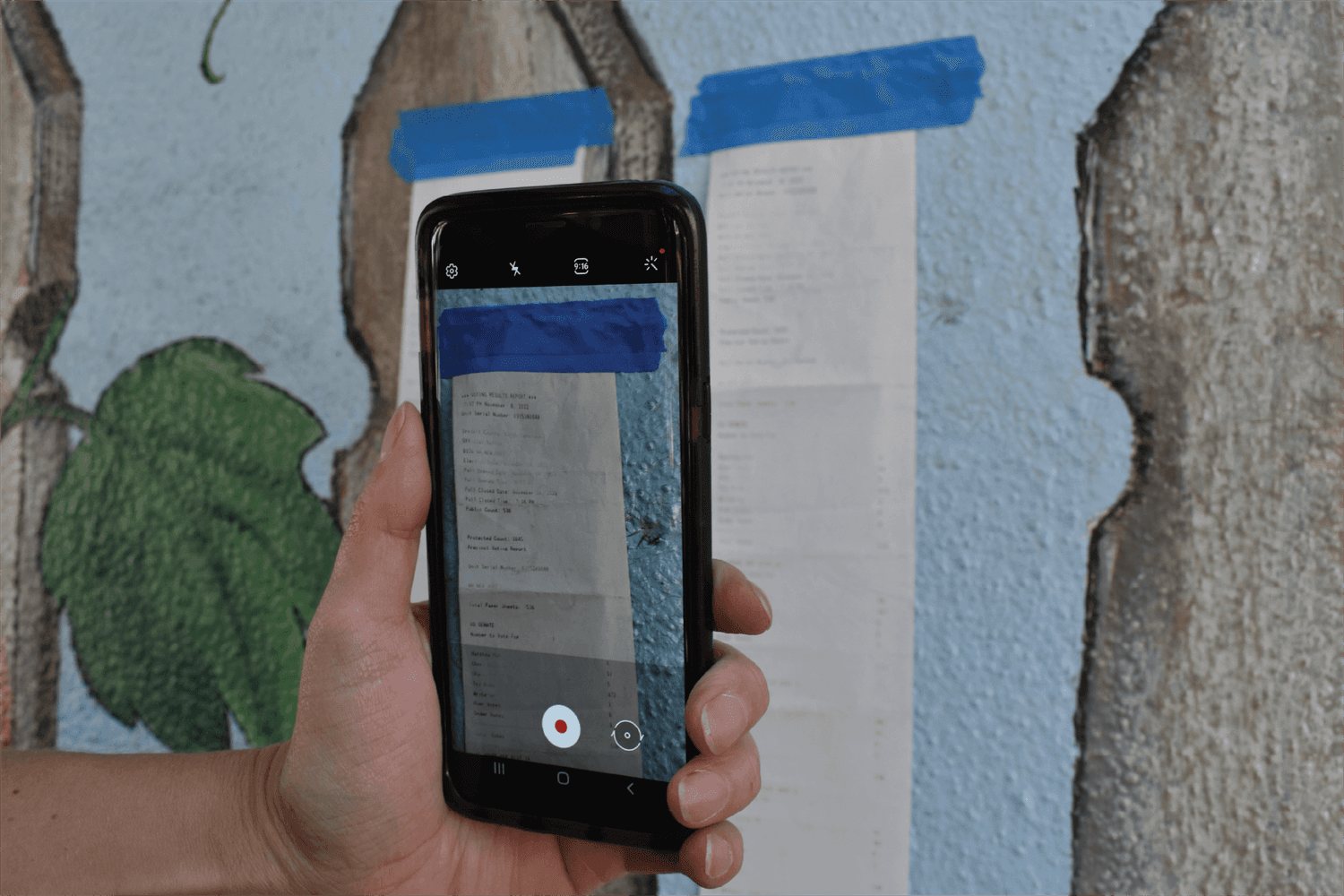
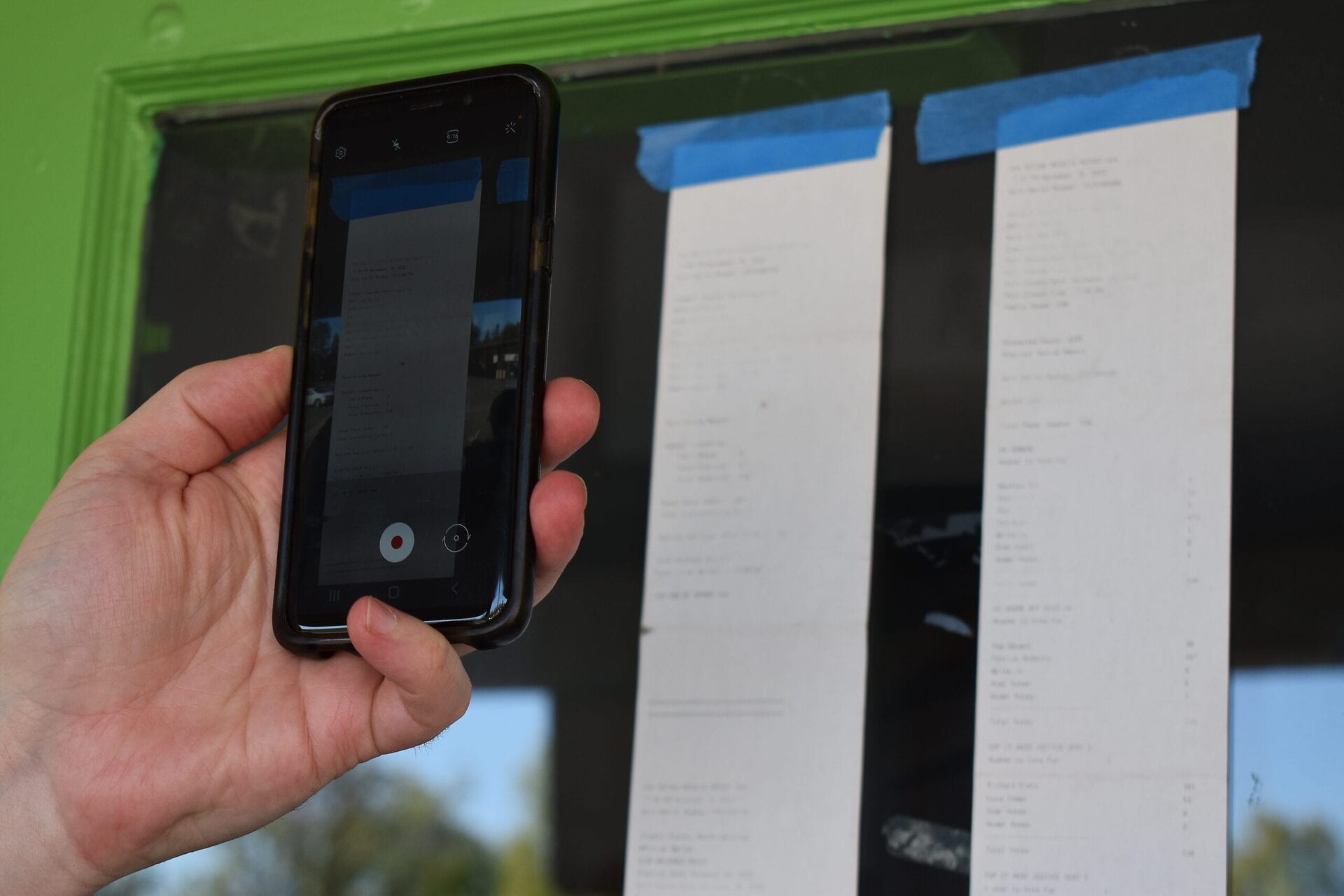
An Actual Vote user about to video-record a poll tape.
Civic engagement means using your knowledge, skills, and energy to improve life for your community, your nation, and the world. When it comes to US politics, common forms include voting, contacting elected officials, advocating for causes, donating, volunteering, attending town meetings, and running for office.
Part of America Counts’s mission is to add something new and powerful to that list: making independent election auditing available to everyone with our Actual Vote app.
You might think that election auditing is only for highly trained professionals with special qualifications and access to sensitive election systems. And indeed, many types of auditing are off-limits to most people. But poll tapes and officially reported results are public information. Anyone who records poll tapes can compare the vote totals to the corresponding official totals, completing a legitimate, non-partisan audit of that portion of the reporting.
With the Actual Vote app, this becomes practical: get the app, make a plan to access poll tapes, and video-record them. No special qualifications or access required. America Counts handles the analysis.
This kind of independent election auditing is a meaningful and impactful method of civic engagement — and Actual Vote makes it available at scale.
Improved election accuracy
Rulers measure length. Elections measure which candidate is favored by more voters — provided that they are accurate.
When an Actual Vote analysis reveals apparent discrepancies between poll tape totals and officially reported results, the accuracy of the official results is in question. How we follow up will depend on the situation, but there are several important possible outcomes:
A non-obvious explanation emerges. Once we ask the elections office, people gain new motivation to investigate, and a previously hidden explanation surfaces that definitively confirms the reporting was accurate after all.
A legal challenge upholds the official results. The court determines that the Actual Vote evidence, for whatever reason, does not warrant overturning the results. For people who accept the court’s reasoning, accuracy is confirmed. For those who remain unconvinced, questions persist — but we’re now alerted to be hyper-vigilant about vote reporting in that area going forward.
Error or fraud is confirmed, but it didn’t change the outcome. The official totals are restated accurately. This is a considerable benefit: a vulnerability in vote reporting was discovered and the official record was restated. It also puts both bad actors and election officials on notice that independent auditors are watching and that errors will be caught.
Error or fraud is confirmed, and it did change the outcome. This is the scenario that justifies the entire effort. A court challenge uses Actual Vote evidence to force the official results to be restated and the correct winner declared. In our years of using Actual Vote we haven’t reached this outcome, and we hope vote reporting never goes this far off track. But history shows it’s a real possibility — which is why we must deploy Actual Vote at scale to catch it if it ever happens.
A defense against bad-faith attacks
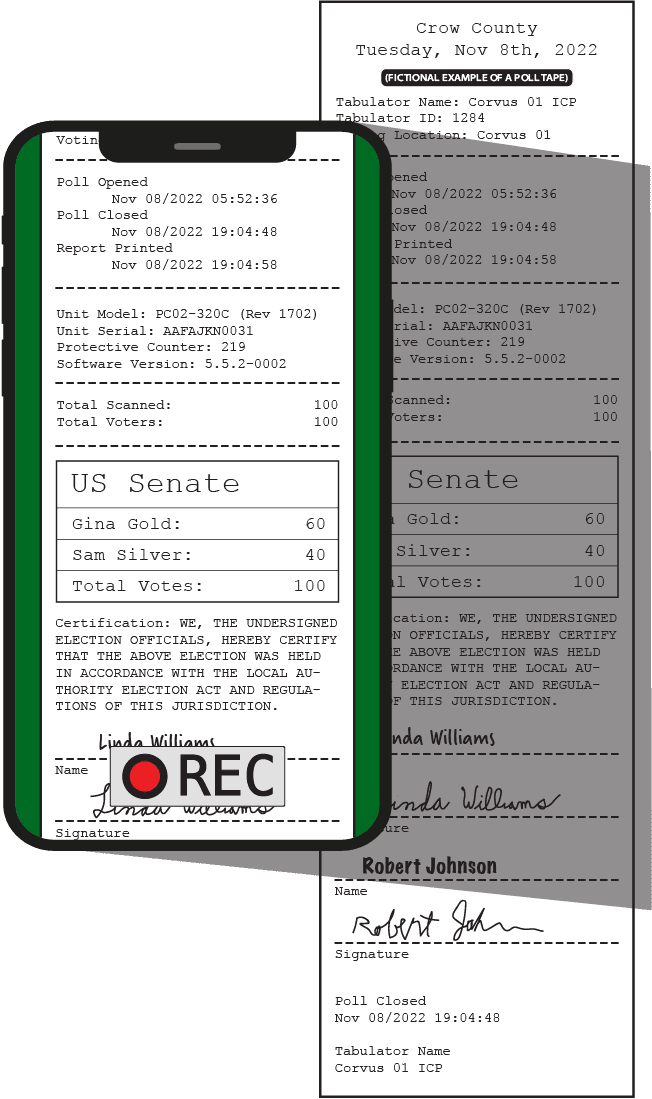
A volunteer records a poll tape — independent evidence that can defend correct results, not only detect errors.
Many election disputes today don’t begin with a detected error. They begin with an allegation — sometimes an honest mistake, sometimes a deliberate falsehood — that the count was rigged or the reporting manipulated. Official results alone can’t put such a claim to rest, because the person making it has already decided the officials can’t be trusted. Answering distrust with more assurances from the distrusted party changes nothing.
Independent evidence can help break the deadlock. Poll tapes recorded by people like you on election night — in the open, outside the government’s chain of custody — are exactly that: a contemporaneous, public record of what each machine reported, created by the community itself. When that record matches the official results, it doesn’t ask anyone to trust the outcome; it lets them check it.
This means that Actual Vote evidence (including the reports that America Counts publishes) helps to defend the accuracy of correct vote reporting, in addition to detecting discrepancies in vote reporting. The same poll tape videos that could expose a real manipulation are the ones that protect the record when nothing went wrong. Honest election workers get their good work independently confirmed instead of smeared, false claims lose the vacuum of evidence they feed on, and because the check is non-partisan, it defends the true result whichever side it favors.
In fact, since America Counts hasn’t yet uncovered an apparent discrepancy in our work with Actual Vote, all of the election transparency generated from our work thus far takes the form of protecting accurate vote reporting.
Improved social well-being

US Airways flight 1549 after Captain Sully landed it on the Hudson River on January 15, 2009.
How should we measure the success of an Actual Vote analysis? Not in dollars — we’re not trying to make a profit. Instead, we use a concept called Social Well-Being (SWB): a high-level measure of the extent to which a group of people as a whole is thriving. Peace, freedom, rule of law, and a strong social contract increase SWB; war, corruption, dishonesty, and lack of accountability decrease it. SWB is the yardstick we use to measure our impact — just as a business measures success in dollars of profit, we measure ours in contributions to SWB.
Consider what happened when Captain Sully landed an Airbus A320 on the Hudson River and everyone on board survived. That event caused two simultaneous adjustments to our national well-being: a slight decrease as the inherent risks of air travel were thrown into sharp relief, and a large increase as it affirmed that our safety systems and first responders can handle extraordinary crises. The trustworthiness of those systems was put to the test, and they prevailed.
Elections need this same level of trustworthiness. When an election lacks it — when people can’t agree on the legitimacy of the outcome and there’s no independent evidence to help them decide — social well-being suffers, regardless of whether the election was actually conducted fairly. Each of the vote reporting disputes we described earlier decreased SWB in a way that could have been avoided with Actual Vote recordings of the relevant poll tapes.
Independent evidence about the accuracy of vote reporting increases the trustworthiness of elections, which generates an increase in social well-being:
- It widens the pool of public evidence available to form an informed opinion on the legitimacy of election outcomes
- It can detect and help rectify errors or fraud, bringing outcomes closer to the true will of the voters
- It provides evidence above and beyond what official sources alone can offer — which, as we discussed, shouldn’t be the whole story for something as high-stakes as an election
- It creates a powerful method of civic engagement alongside voting, advocacy, and contacting elected representatives
This is why we publish every finding, link to every recording, and invite anyone to check our work. The goal isn’t just to audit elections — it’s to build the kind of shared evidentiary foundation that a healthy democracy requires.
A few more things it produces
Beyond the benefits above, independent election auditing using poll-tape evidence does several other things worth naming:
- It deters. A known, growing public archive of precinct tapes changes the incentives for anyone tempted to manipulate vote reporting — and for anyone tempted to invent a manipulation that never happened. The deterrent works whether or not any specific problem is ever caught.
- It survives. Because volunteers capture the evidence independently, on election night, it exists outside the government’s chain of custody — it can’t be quietly altered, lost, or destroyed by the same offices whose work it checks, the failure mode behind several of the stories on the previous page.
- It’s fast. An independent comparison can surface a discrepancy within days of the election, while results are still being finalized — not a year later through litigation.
- It’s already real. This isn’t only hypothetical. Every Actual Vote analysis we publish is itself a record of the method working on a real election — independent evidence anyone can check. See our published reports.
Want to go deeper? See the Philosophy chapter of our Technical Manual for a fuller treatment of the benefits of Actual Vote.