
Step 4 of 7
Make Your Plan and Get Ready
Everything to do before election day, start to finish.
Want to use Actual Vote in the next election? This page walks you through the whole process: first you choose how you’ll get access to poll tapes, then you get set up and ready to go. You don’t need to download the app to read it. Many people find it easiest to see the whole picture first, then come back and work through the steps.
Before you get started
Three things worth knowing before you download the app and make your plan:
It’s legal. Recording poll tapes is legal in every state where we operate. Poll tapes contain public information, and observing or video-recording them in public is a protected activity. See Using Actual Vote Is Legal for why, or your state’s page for the local specifics.
Your safety matters. Most Actual Vote recording happens in public spaces during or shortly after normal polling hours, and thousands of people have done it without incident. That said, we take safety seriously and have put together practical guidance for staying safe while recording — including tips on going with a partner, planning your route, and what to do if you’re questioned. See the Health, Safety, and Practicality Statement.
Your privacy is protected. The Actual Vote app collects only what’s needed to make the Actual Vote system work: your recordings and basic location data so we can match tapes to precincts. We don’t sell your data, we don’t track you beyond what the app requires, and you can review our full policies before you sign up. See our Privacy Policy and User Agreement.
Part 1 of 2
Make your plan
Choose how you’ll get access to poll tapes.
1. Learn the six ways to access poll tapes
There are six ways to access poll tapes to record with the Actual Vote app. They’re numbered the same way on every state page, and the numbers aren’t a ranking: each has its own strengths. Some catch the tape earlier in its chain of custody, some cover more of the vote, and some take less time or are open to more people. Here’s how they compare:
| Way to help | Where it works | What it takes | Chain of custody | Votes it covers | Best for |
|---|---|---|---|---|---|
| 1. Record posted tapes at polling places | States that post tapes outside | 1–3 hours on election night | Earliest | Election day, at each polling place you visit | Most volunteers in posting states |
| 2. Be there at the close or observe the count | States that post inside or count in public | Being at one place at the close | Earliest | Election day at one place, or a whole county at a central count | One location on election night |
| 3. Record early-voting tapes | Most states with early voting | A call, then election night | Early | Early votes, often the biggest share | The early vote |
| 4. Become a poll worker, watcher or observer | Any state, with an appointment | A full election day | Earliest | One polling place | People already serving |
| 5. Visit the elections office | Any state | A few hours, your schedule | Later | Many precincts, all methods | A whole county |
| 6. File a public-records request | Any state | Weeks of waiting | Latest (copies) | Whatever you request | Full coverage, with patience |
A note on what to expect. The information on this page and throughout our site reflects our best understanding of poll tape access in each state, based on research into state law and direct conversations with election officials. We completed a comprehensive, primary-source review of all 50 states and DC in June 2026 — but laws, procedures, and local practices can change, sometimes at the last minute.
In some states, accessing poll tapes is straightforward. In others, it takes more effort and creativity. That’s natural variation, not a barrier — it just means your decision process will look different depending on where you are.
The information here will be right much of the time, but we can’t guarantee it reflects exactly what will happen in practice at your specific polling place or elections office in the next election. Procedures can also vary at a more local level than what we’ve been able to check. The best way to confirm what to expect is to contact your local elections office directly.
Think of the information below as a well-researched starting point. Confirming the details with your local officials is the final step in making a solid plan.
Here’s more detail on each method:
1. Record posted tapes at polling places
As of 2026, in Alabama, District of Columbia, Florida, Georgia, Kentucky, Louisiana, New Mexico, Ohio, Oklahoma, Pennsylvania, and South Carolina, the law requires poll workers to post poll tapes on the outside wall of the polling place after the polls close. (Nevada is different: its vote centers don’t post tapes, but each county posts a signed copy of its results outside the courthouse or counting facility.) It is legal for the general public to view, photograph, or video-record these poll tapes.
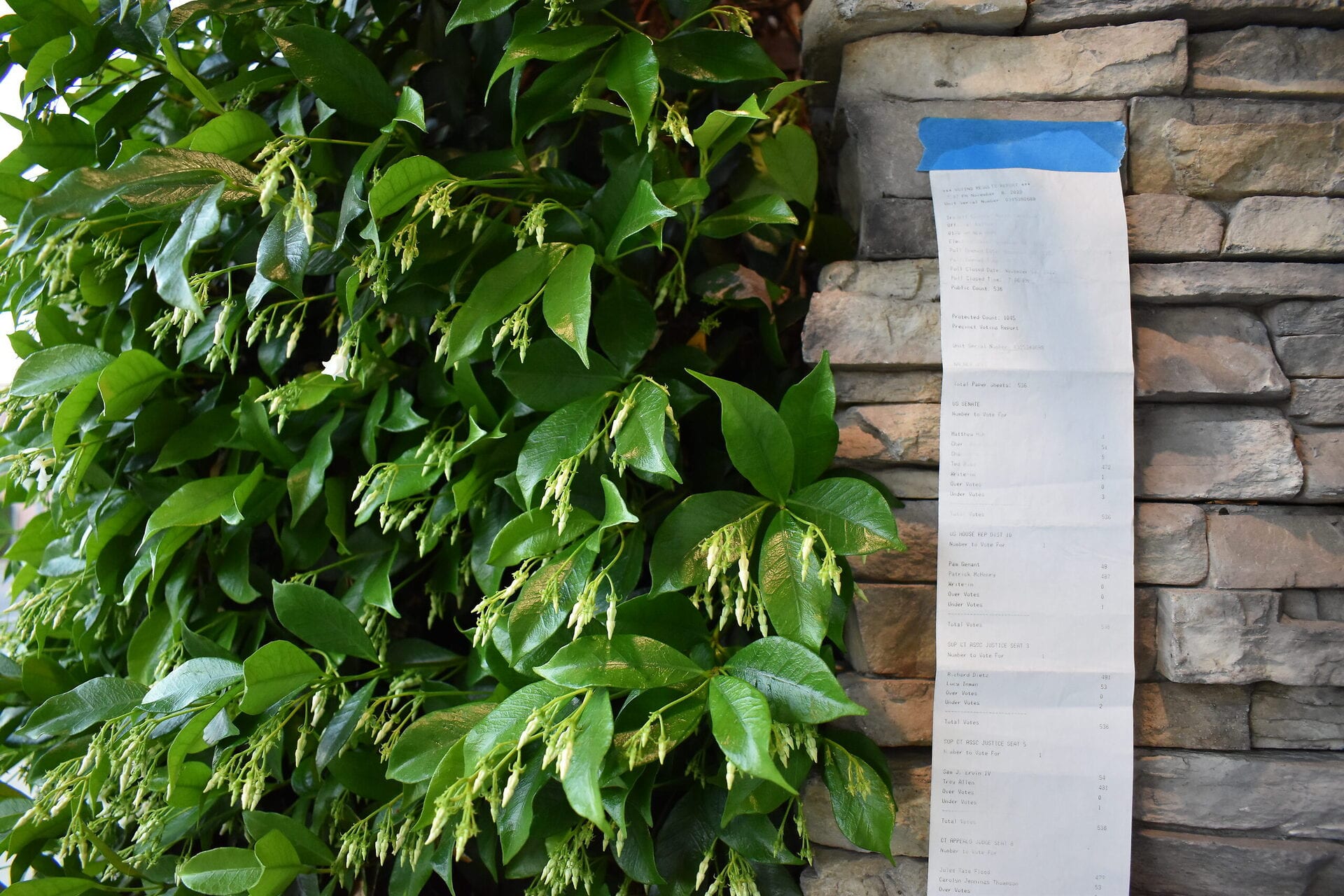
On election night, you visit one or more polling places after closing time to video-record the posted tapes. Check your state’s poll closing time before you plan — and note that the published closing time is when poll workers begin the closing procedure, not when the tape goes up. When the tapes go up is unpredictable. It depends on how busy the polling place was, how experienced the poll workers are, and what else is going on around closing time — anyone already in line when polls close is entitled to vote, and the closing procedure waits for them. In many cases the tapes are up an hour or two after closing time. In many other cases it takes longer, or happens sooner. How long they stay up varies just as much: some come down well before they should, some stay up for days. Heading out about an hour after polls close has worked well for a lot of people, and will work in plenty of cases — but we can’t promise how it will go where you are. If polling places near you tend to have a line at closing time, go out later. Either way, plan on a second pass for anything that isn’t up when you arrive. These videos are particularly strong evidence about vote reporting because they are taken shortly after the poll tapes are printed — early in the chain of custody.
This method is usually limited to poll tapes corresponding to election day voting. For early voting, see early-voting tapes below; for absentee voting, you’ll need one of the other methods below.
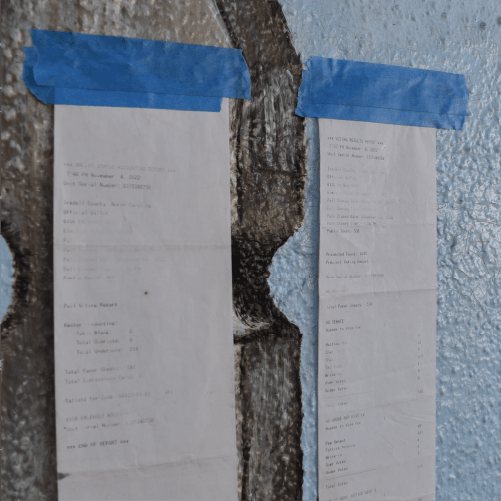
Poll tapes posted in public view on the wall of a polling place on election night after closing time.
See a detailed example of how to make a plan to visit polling places on election night based in Broward County, Florida.
2. Be there at the close or observe the count
In many states the tape isn’t posted outside, but the public can still see it at closing time. It may be posted inside the polling place or read aloud at a public count at the close, or the votes may be counted at a central location, such as the county elections office, that’s open to observers. Be there when it happens, ask whether you may video-record, and record the tape or the posted results with the Actual Vote app. Where no tape is printed, the totals are sometimes read aloud, and that can be recorded too. Realistically this is one location a night, but a central count can cover a whole county. Your state page says whether this applies where you are.
3. Record early-voting tapes
In many states, most ballots are now cast early. Early-voting tabulators usually store votes for the whole early-voting period and print one results tape per machine after polls close on election day. Where that happens varies by state and county: at the early-voting site or vote center (Michigan holds a public canvass at each early-voting site at 8 p.m.), at the county elections office, or at a central count (Arkansas, North Dakota and West Virginia open theirs to the public). In Cobb County, Georgia, our volunteers video-recorded 18 of the county’s 21 advance-voting tapes posted at the main elections office on election night in June 2026. In some states early votes are simply on the polling-place tape, and in all-mail states there is no early-voting tape at all.
Use case 3 on your state’s page says what we know, and sometimes the honest answer is that we don’t know yet. Either way, call your county elections office ahead of time and ask where and when the early-voting tapes will be printed, and whether you may observe and video-record them. If they don’t have a plan to show them, you can politely ask them to display the tapes. See a detailed example based on Cobb County, Georgia. Each early-voting tape covers one machine and usually many precincts. Where a site has several machines, record all of their tapes: some states, like North Carolina, report early-voting results for a whole site at once. Checking the tapes also takes official results broken down by tabulator, which a records request can get, as it did in Cobb.
4. Become a poll worker, watcher or observer
If you’re serving as a poll observer or watcher, you’ll have greater access at your polling place. In many cases you’ll be able to observe poll tapes inside the polling place as they are being printed during the closing procedure, or shortly after. This usually extends to taking Actual Vote videos.
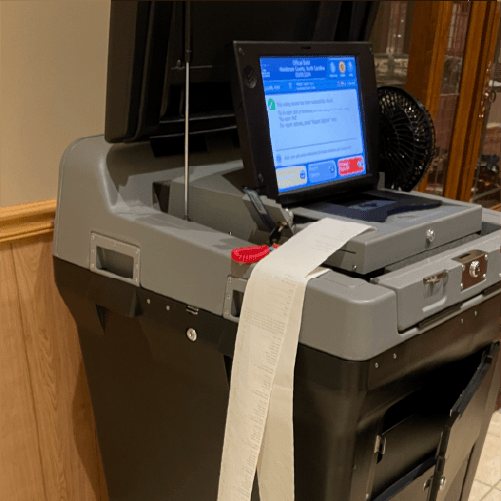
Poll tapes being printed.
See more details about Actual Vote for poll workers or observers.
5. Visit the elections office
You can contact your county elections office to schedule an appointment to view poll tapes and record them with Actual Vote. The advantage of this method is that they will often provide you with many or all of the poll tapes from each precinct in the county — giving you far greater coverage than a single night of polling place visits.
You can use this method in any state.
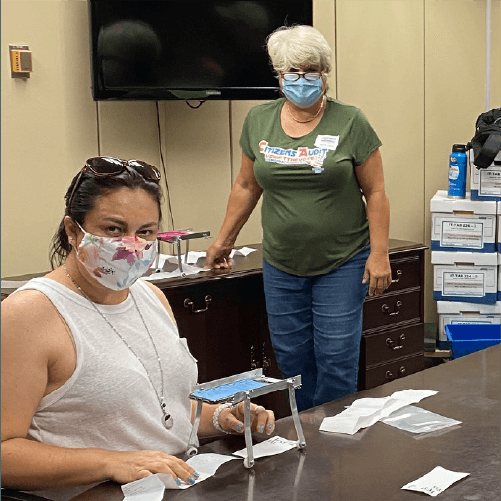
Actual Vote users video-recording poll tapes in the Broward County, Florida Board of Elections office in 2020.
See a detailed example of how to do this.
6. File a public-records request
You can file a FOIA request with your local board of elections for scanned PDFs or physical copies of poll tapes from precincts in your county. This method is available in any state and can cover any county — even outside your home county.
The trade-off is time: FOIA requests require patience and follow-up, and the chain of custody is longer since you’re receiving copies rather than recording originals shortly after printing.
See a detailed example of how to do this.
2. Check your state
Laws and policies around posting poll tapes vary by state. The map below is live — select your state for its full Actual Vote page, including what the law says, when polls close, and your county’s election website:
- 1. Poll tapes posted outside, in public (12)
- 2. Poll tapes posted inside, or at closing time only (17)
- 3. Access poll tapes after election night (6)
- 4. Watcher credential needed to access poll tapes on election night (8)
- 5. Observe the count (5)
- 6. Varies by county (3)
If your state is in Group 1 — poll tapes posted outside, in public (dark green), you’re especially encouraged to visit polling places on election night and record the posted tapes; you can often cover several in one evening. Group 2 — posted inside, or at closing time only states can also work if you’re there at the close. The legend on the map explains each group.
The other methods of poll tape access (elections office appointment, public records request, observing the count) are possible in most states. Full state-by-state details: Actual Vote in Your State.
3. Choose your plan
Don’t want to read all the details? Answer three quick questions and we’ll suggest a plan that fits your state, your device, and how much time you have:
Your Actual Vote plan
Prefer to dig in yourself? Put together a plan appropriate for your location — usually your home county, though some people travel to other counties. Find your state-specific details, relevant state law, and county elections-office contacts on the Actual Vote in Your State pages.
Then use one of these detailed examples as a template for your own plan:
- Visiting polling places on election night — most accessible for first-timers in states that require public posting
- Serving as a poll observer or watcher — for those already serving in observer roles
- Making an elections-office appointment — to record many tapes at once during business hours
- Filing a public records request for poll tapes — for comprehensive coverage with patience
- When you can’t easily access tapes in your area — finding a meaningful way to help where access is hard
Part 2 of 2
Get ready
Get set up, get trained, and line up your team.
Once you know how you’ll get access to poll tapes, it’s time to get ready. None of this takes long, but all of it goes better if you start early.
4. Get the app and make a practice recording
- Get the Actual Vote app. It’s free on iPhone, iPad, and Android, and runs on iOS 15 or later and Android 8.0 or later — roughly any phone sold since 2017. Check the device requirements if you’re not sure.
- You’ll need a Google account to log in. If you don’t have one yet, installing early gives you time to make one.
- Open the app and follow the prompts to get set up.
- Take a practice recording of our practice poll tape, a grocery receipt, or anything else, and make sure it uploads. You’ll get a prompt that says so. You can watch it afterward in the Actual Vote Video Archive.
Installing early matters. You don’t want to travel to a polling place on election night only to find your phone is too old to run the app.
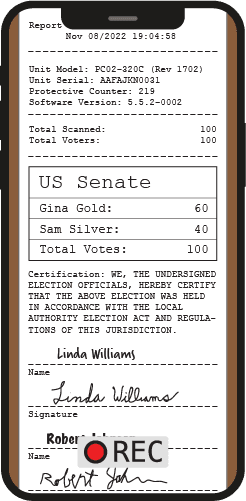
Great recordings are in focus, well-aligned, legible, and well-lit:
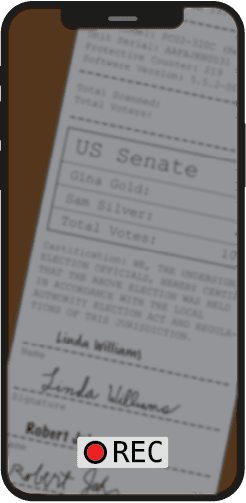
Bad recordings are blurry, crooked, hard to read, and poorly lit:
Record one poll tape per recording. A recording with a single poll tape is the easiest for a person or an AI system to transcribe accurately. Two or more tapes in the same recording make transcription much harder. If several tapes are posted together, record each one separately.
For more on technique — framing, low light, and uploading over a weak connection — see How to make a good recording in our practical guide.
5. Explore the Actual Vote Video Archive
Every Actual Vote recording ends up at av.democracycounts.org, the Actual Vote Video Archive. It’s worth a visit before election day.
- Browse. Anyone can browse the poll tape videos other Actual Vote users have taken. Try searching for poll tapes from your state. If there aren’t any yet, you could be the first.
- Find your own videos. Log in with the Google account you use for the app and go to the My Actual Vote Videos tab. Your practice recordings are there, along with any other videos you’ve taken.
- Uploads happen automatically. The app sends your recordings to the archive on its own. There’s nothing extra to do.
- Recordings are reviewed before they’re published. America Counts reviews every recording except practice recordings to make sure it doesn’t contain anything inappropriate, then approves it. Approved recordings appear on the archive’s main page for anyone to see.
With every recording collected in one place, it’s easy for America Counts — or anyone else — to find all the poll tape videos from your county after the next election, transcribe the vote totals, and compare them to the official results. We publish our findings on our reports page.
6. Get in touch and get trained
Send us an email at info@democracycounts.org to let us know you’re planning to use Actual Vote. Tell us your state and county, and which method you’re leaning toward.
We’ll set up a training call with you, either one-on-one or with a few other people from your area. It’s the best way to get ready: we’ll walk through the app with you, go over what to expect in your state and county, help you make a realistic plan, and answer your questions.
We can also:
- Connect you with other Actual Vote users in your area, including coordinators who can slot you into their existing plans
- Place the poll tape videos you plan to take in our analysis queue, so we’re expecting them
- Add you to our mailing list
If you want a commitment that your recordings will be analyzed in time for a particular election, get in touch well in advance — especially if you’re planning a big effort, or working somewhere we haven’t analyzed before.
7. Join or start a team
You can use Actual Vote on your own, and many people do. But a team covers more ground, and it’s safer and more fun.
Join a team. In some areas, coordinators are already organizing Actual Vote efforts. When you get in touch, we’ll connect you with one if there’s one near you.
Start a team. If there isn’t one near you, start one. Two or three friends or family members is enough, and we’ll help you coordinate. Useful roles:
- A coordinator who splits up assignments — who covers which polling places, in what order. They don’t need any experience, just a willingness to organize. A shared spreadsheet usually does the job.
- Recorders who each take a set of polling places on election night.
- A partner for each recorder, so nobody goes out alone after dark.
- At an elections-office appointment, one person on the camera, one moving tapes through, and one keeping track of which tapes have been recorded. A few hours of teamwork can produce dozens or hundreds of recordings.
One rule matters more with a team: say nothing on a recording you wouldn’t want scrutinized in public. Recordings become public, audio included. Not talking is safest; brief, on-topic speech like the precinct name is fine. Over a long session, conversation tends to get casual, so watch for that. More in Working with other volunteers.
8. Your timeline to election day
As soon as you decide to take part
- Read this page and your state’s page, and choose your method
- Install the app and make a practice recording
- Email us to set up training and, if you’d like, connect with a team
- If you want to serve as a poll observer or watcher, start the credentialing process now. There are usually sign-up deadlines.
A few weeks before the election
- Do your training call
- Firm up your team and who’s covering what
- Contact your elections office to confirm what to expect: whether and where poll tapes will be posted, or what their process is for appointments and records requests
- For election night, list the polling places you’ll visit and the order you’ll visit them in
Election week
- Update the app and make one more quick practice recording
- Charge your phone, and bring a battery pack if you have one
- Check your state’s poll closing time
- Let someone know your plan if you’re going alone, or make final preparations with your recording team
Election night
- In Group 1 states, head out after polls close — about an hour after closing has worked well for many people
- In Group 2 states, be at your polling place when it closes, since that’s when you can see the tape
- If you’re a poll watcher or observer, follow your credential’s rules for the closing procedure
- Record one poll tape per recording, say nothing you wouldn’t want public, and check that each recording uploads
- Plan on a second pass for any tapes that weren’t up yet when you arrived
After the election
- If you’re recording at the elections office or have filed a records request, this is when that work usually happens. It’s also how you cover early and absentee voting.
- Let us know what you recorded, and see what happens after you record
A note on interacting with election offices. Several of the methods above involve contacting your local elections office — to confirm poll tape policy, schedule an appointment, or file a public records request. When you do, please be respectful of their time. Election administrators are public servants doing difficult, often thankless work under enormous pressure, especially around election time. Make your requests specific, professional, and reasonable. Follow proper channels. Don’t call repeatedly if you don’t get an immediate response. America Counts is committed to maintaining a respectful relationship with election offices, and we ask the same of all Actual Vote users.
When you become an Actual Vote user, you join a nationwide community of people ready to strengthen democracy by independently auditing vote reporting. For the full practical guide to using the app, see Using Actual Vote.