
2026 Henry County, MO Primary Actual Vote Analysis One complete unit of Actual Vote analysis work: one election in one state, with all the submissions, transcriptions, comparisons, investigations, and findings that produce one published report.
August 4, 2026 Primary Election · Henry County, Missouri · records-request analysis begun August 2026 · ongoing
av-report-20260804-mo-henry-v1.0
- Comparisons
- 41
- Votes audited
- 2,231
Executive Summary
After the Missouri August 4, 2026 Primary, a Missouri election transparency advocate had a procedural question about a close race in Henry County: the Presiding Commissioner contest had been decided by a couple hundred votes, one precinct appeared to have reported hours later than the rest, and the pieces he could see didn’t quite fit together. It was exactly the kind of question poll tapes exist to answer — so he contacted America Counts for help, and we’ve been working with him since to drive it toward a resolution the evidence can support. (We are always glad to get that call: helping people replace speculation with records is what Actual Vote is for. If you have a question like this in your county, we’re happy to advise.)
This report is unusual for us in two ways, and we publish it mid-stream because both are useful now. First, it is ongoing. Missouri does not post poll tapes at precincts — they are held by the county election authority — so this analysis proceeds by public-records request rather than by volunteers recording tapes on election night. The county has released one tape so far: the Fairview precinct tape produced during its mandatory post-election recount, which is part of the public audit record. We have requested the election-night tapes for all ten reporting units, the county has declined on a legal ground we believe misreads the statute, and that question — whether Missouri poll tapes are open records under the Sunshine Law — is now before the Missouri Attorney General’s office. Second, the most valuable content so far is not a comparison table but a worked example of how a records requester and a county election office can deal with each other well: over a month of correspondence, every factual question asked of the Henry County Clerk was answered, every answer checked out against the county’s own documents, and every initially suspicious-looking circumstance dissolved under scrutiny.
The one released tape gave us our first analysis of Missouri records — a milestone for the project, and we compared every value on it against the certified results: 41 comparisons covering 2,231 votes, with 40 exact matches and one one-vote difference that the County Clerk, reviewing our finding, agrees most likely reflects a marginally marked ballot read differently on a second scan. No apparent discrepancy remains. If the election-night tapes are released, this page will grow into a full ten-precinct analysis.
New to Actual Vote? Start here.
1. Scope
| Analysis ID | 20260804_usa_mo_henry |
|---|---|
| State | Missouri, United States |
| Election | August 4, 2026 Primary Election |
| Analysis Window | After certification (August 7, 2026). Records correspondence began August 8, 2026; the Fairview tape comparison was completed September 14, 2026. The analysis remains open pending resolution of the records request for the election-night tapes. |
| Counties Represented | Henry |
| Recording Team | None — Missouri does not post poll tapes at precincts, and no tapes were recorded on election night. All records in this analysis were released by the Henry County Clerk in response to a citizen’s Sunshine Law request. |
| Poll Tape Access Method(s) | Public-records request under Missouri’s Sunshine Law (RSMo Chapter 610), made by a Henry County citizen working with America Counts. The county released one poll tape (the audited precinct’s recount tape) as part of the public audit record; its position on the remaining tapes is the open legal question described in Section 9. |
| Official Results Source | The certified Statement of Votes Cast and per-precinct summary reports for the August 4, 2026 Primary, provided by the Henry County Clerk (printed August 7, 2026) and published on the county’s website, together with the unofficial election-night Statement of Votes Cast and the county’s election-night precinct report sequence, also provided by the Clerk. |
| Analysis Status | Ongoing. One of ten precincts compared (the precinct whose tape the county has released). The records question governing the other nine is pending before the Missouri Attorney General’s office. |
2. Results in Brief
| Metric | Total |
|---|---|
| Submissions Received | 1 |
| Transcribable Submissions | 1 |
| Comparison-Eligible Transcribed Values | 41 |
| Possible Comparisons | 41 |
| Exact Matches | 40 |
| Explained Matches | 1 |
| Apparent Discrepancies | 0 |
| Votes Audited | 2,231 |
| Average Votes per Transcribed Value | 54 |
| Precincts Compared | 1 of 10 |
The one Explained Match — a one-vote difference in an unopposed race, which the County Clerk reviewed and concurs most likely reflects a marginal mark read differently on a re-scan — is fully itemized in Section 7.
3. Summary of Findings
The advocate who brought us this case started from three factual premises: that the second-place commissioner candidate had led in every precinct except one; that the one exception had reported two hours after everyone else; and that the margin sat just above the threshold that would have forced the race into Missouri’s mandatory audit. Working together, and using only records the county itself released, we tested all three. All three turned out to be wrong — the margin was about ten times the audit threshold, the candidate lost three tallies (not one) in an ordinary town-and-country pattern, and the county’s own election-night print log shows the “late” precinct arrived fifteen minutes behind its nearest neighbor, not two hours behind everyone. That is the process working as it should: a sincere question, tested against documents, answered — in this case in the county’s favor, and in several instances with records the requester didn’t know existed. Section 8 tells the story; Section 11 distills it.
The comparison itself is small but clean: every value on the one released tape matches the certified results except a single one-vote difference in the County Clerk race (tape 127, certified 126), which both America Counts and the County Clerk regard as most plausibly a marginally marked ballot that two scanner passes read differently. Nobody had noticed it before this analysis; it changes nothing (the race was unopposed); and it is precisely the kind of small, benign, otherwise-invisible reporting-chain divergence that tape-versus-official comparison exists to surface.
4. Why This Analysis Matters
In 2002, the governor’s race in Alabama turned on a single precinct in Baldwin County, where roughly 6,300 votes vanished from one candidate’s total in a late-night “correction” after observers had gone home. The voting-machine vendor later confirmed that the precinct-level printout — the poll tape — had shown the correct totals; the error, or worse, happened downstream. Nobody preserved that printout. The recount was blocked, the ballots were destroyed on schedule, and the question has now been argued for more than twenty years without resolution. One photograph of one poll tape would have settled it.
Henry County 2026 began with the same shape: a close race for Presiding Commissioner, decided by 236 votes, in which the losing candidate carried most precincts but lost the county’s largest — the one precinct that reported hours later than expected. The difference is what happened next. In Baldwin County, the evidence was never examined and is now gone. In Henry County, a citizen asked for the records, the county produced most of them, and the premises dissolved one by one under documentary scrutiny — while the tapes that would finish the job remain, preserved under Missouri’s 22-month retention law, awaiting a legal answer about public access. This report exists so that either ending — confirmation or correction — is reached on evidence, not left to two decades of dueling narratives.
5. What Is an Actual Vote Analysis?
An Actual Vote analysis is an independent comparison of vote totals transcribed from poll tapes to the corresponding officially reported results, serving as a double-check of the accuracy of vote reporting.
Vote reporting is the process by which local-level vote totals from tabulating machines are aggregated to produce the official countywide and statewide results. This process is distinct from vote counting (which covers everything from voter registration through ballot tabulation). An Actual Vote analysis audits only the reporting step — not the casting, counting, or tabulation of ballots.
The methodology is an independent batch-comparison audit of the vote-reporting chain — the same tape-totals-versus-published-results check that risk-limiting audits perform on randomly sampled batches, conducted here at full coverage of the audited precincts. Batch comparison is a peer-reviewed technique that has been in use for over a decade: Colorado has run statewide risk-limiting audits built on it since 2017 (C.R.S. § 1-7-515), and the Election Assistance Commission, Verified Voting, and the Brennan Center for Justice all endorse rigorous post-election auditing. Actual Vote is not a risk-limiting audit — it does not compute or claim a statistical risk limit, and its claims extend exactly as far as its coverage.
For more information, see How Actual Vote Works and Why Actual Vote Is Trustworthy on our website. For the full technical methodology, see Section 8 of the Technical Manual.
6. Methodology Notes for This Analysis
How vote reporting works in Missouri
Missouri does not post poll tapes at precincts. Under the Secretary of State’s closing rule (15 CSR 30-10.150), each tabulator prints at least one results tape at the close of polls; the election judges reconcile the tape’s ballot count against the machine’s counter, the precinct register signatures, and the ballots marked; and the tapes are then transported to the county election authority together with the recap sheets and other paperwork — separately from the voted ballots and paper cast-vote records, which travel in sealed tamperproof containers. Missouri’s signed totals document is the four-judge, bipartisan statement of returns; the tape itself carries a signature attestation block in Henry County’s practice, but state law does not require judges to sign it. For the state-by-state picture, see Actual Vote in Missouri.
Henry County runs Unisyn OpenElect FVS precinct scanners with OpenElect FVT ballot-marking devices and electronic pollbooks. The county has ten reporting units: nine election-day polling places and a countywide absentee count.
What the released tape is — and is not
The one tape released so far is not an election-night tape. Its own header shows it was printed on Friday, August 7, 2026 — certification day — with the polls “opened” at 12:26 PM and “closed” at 12:51 PM: it is the product of the county’s mandatory post-election recount, in which the randomly selected precinct’s ballots (Fairview, 188 ballots) were re-scanned in a 25-minute run. Missouri requires this recount (15 CSR 30-10.110 and 30-10.060(4)), and its results are filed in the public records of the election, which is how this tape came to be released.
This distinction matters for what the comparison establishes. An election-night tape captures what the machine said before results traveled to the county — the usual Actual Vote checkpoint. A recount re-scan is a different and also valuable checkpoint: an independent second machine reading of the same physical ballots, three days later, compared here against the certified results built from the election-night reading. Agreement between the two means two separate scans of the ballots produced the same numbers the county published — with one instructive one-vote exception, discussed below.
Data collection and transcription
All documents in this analysis were released by the Henry County Clerk in response to a Sunshine Law request by a Henry County citizen, working with America Counts: the certified Statement of Votes Cast and precinct summary reports, the unofficial election-night Statement of Votes Cast, the county’s election-night precinct-report sequence, the full certification packet (canvass documents, ballot-accounting certifications, audit certifications and hand-tally sheets), and still-image scans of the Fairview recount tape. The tape values were transcribed by hand from the county’s scans and compared at the precinct × contest × choice grain against the certified Fairview precinct report, with the final ballot question compared against the certified Statement of Votes Cast. Because this analysis’s inputs are county-released scans rather than app-recorded video, transcription was fully manual, with each value double-checked against magnified crops of the source images. Ten of the 41 comparisons are opened all the way up — crop beside certified figure, with the exact citation — on the sample comparisons page.
7. Discussion of Results
Forty exact matches, and one explained match
Every candidate and ballot-question value on the Fairview recount tape was compared against the certified results — 41 comparisons covering 2,231 reported votes across 22 contests and questions on four ballot types (Republican, Democratic, Libertarian, and non-partisan). Forty matched exactly. Both documents also agree on the precinct’s ballot universe: 188 ballots cast, of which 147 were Republican.
The forty-first is the County Clerk race, in which the incumbent clerk ran unopposed: the recount tape shows 127 votes; the election-night results and the certified results both show 126. The same 188 ballots produce both numbers — the difference is absorbed by the undervote line — which means one ballot was read as a vote by one scanner pass and as a blank by the other. The classic cause is a marginal mark: a light pencil oval, a check mark instead of a filled bubble, read differently by two passes. We asked the County Clerk about the difference directly. Her written answer: the recount team had not been aware of it (the unopposed race was not among the contests selected for hand-counting), she did not personally observe the ballot in question, and she “would make the same presumption — that a marginal mark may have been interpreted differently during the re-scan.”
We classify this as a match with a plausible explanation — explained, not confirmed. Confirming it would require examining the ballot itself, which Missouri law reserves to courts, grand juries, and legislative bodies. It is one vote, in an unopposed race, with a mechanism both parties find plausible. It is also, in miniature, the entire case for this kind of checking: a divergence between two official documents, produced by the county’s own processes, that nobody — not the recount team, not the canvass, not certification — had noticed until an independent comparison lined the documents up.
What the county’s records resolved
The request that produced these records began with three specific concerns, and the county’s own documents resolved all three:
The late precinct. The Benson Center — the county’s largest polling place, and the one precinct the second-place commissioner candidate lost decisively — was believed to have reported two hours after every other precinct. The county’s election-night precinct-report sequence, timestamped as each precinct’s results arrived, shows otherwise: precincts arrived in a steady stream from 8:55 PM to 9:58 PM, and Benson Center was last by roughly fifteen minutes, not two hours. The clerk’s explanation — the county’s largest location, voters in line at the 7:00 PM close (Missouri law requires everyone in line be permitted to vote), sixteen ballot styles, 9,225 ballots to reconcile, and a newly promoted supervisor team performing a careful close — was independently corroborated by the Republican member of the county’s bipartisan verification team, and is consistent with every timestamp in the county’s own records.
The margin. The race was believed to have been decided by 234 votes, and separately believed to be “just above” the 0.5% threshold that triggers Missouri’s mandatory close-margin audit. The records show the election-night margin was exactly 234; the certified margin is 236, the change fully accounted for by seven provisional ballots approved and counted at canvass. And the margin — about 5.2% of votes cast in the race — was never near the audit threshold. (That threshold did trigger elsewhere in this election: a township committeewoman race ended in an exact 78–78 tie, which the county duly hand-counted and confirmed.)
The precinct pattern. The second-place candidate was believed to have carried every precinct except Benson Center. The certified results show he lost three of ten tallies — Benson Center, Clinton Ward 1 (his opponent’s strongest precinct), and the countywide absentee vote — a conventional town-and-country split in which his opponent carried the Clinton city area and he carried the rural townships. Benson Center, Clinton’s polling place, fits the pattern of its neighboring city ward; it is not an outlier.
What this comparison does and does not establish
The comparison verifies the reporting of 2,231 votes in one of ten precincts, using a recount re-scan rather than an election-night tape. It does not verify the other nine precincts, and it does not capture the election-night machine state that a same-night tape would. The nine election-night tapes exist, are preserved under Missouri’s 22-month retention requirement, and are the subject of the pending records question. Until they are compared, the certified countywide results — including the 236-vote commissioner margin — are corroborated by this analysis only to the extent of Fairview’s share of them.
8. The Records-Request Story So Far
This section is the part of this report we most hope other citizens — and other election offices — will read: a month of correspondence in which neither side postured, every question got a factual answer, and the answers were checked against documents rather than taken on faith.
Early August. Days after certification, the requester sent the Henry County Clerk a Sunshine Law request for the poll tapes, statements of returns, and machine-generated reports from the primary, offering to pay copying fees. The county released precinct voter counts and the mandatory audit results for the randomly selected precinct, but declined the tapes, citing the retention statute discussed in Section 9.
Mid August. The requester, now working with America Counts, wrote back: a reconsideration request setting out the statutory reading, and a direct question — why had the Benson Center reported so late? The clerk answered in detail: the county’s largest polling place, voters in line at the 7:00 PM close, sixteen ballot styles, 9,225 ballots to account for, and a newly promoted supervisor team recounting the unvoted ballots to be sure before driving in. She maintained the legal denial.
Late August. The county produced its full certification packet and, later, its election-night records. Those documents corroborated the clerk’s account in detail — down to a timestamped print log showing each precinct’s results arriving through the evening — and separately corrected every one of the requester’s starting premises (Section 7). The Republican member of the county’s bipartisan verification team, contacted independently, confirmed the clerk’s account of election night. Meanwhile, our comparison of the released tape surfaced the one-vote County Clerk difference that no one — including the county — had noticed.
Early September. Asked about that difference, the clerk answered candidly: the recount team hadn’t been aware of it, and she shared our presumption of a marginal-mark re-read. Asked how tapes are physically handled, she described them returning from precincts as paperwork, sitting unsealed in the vault through certification, and being sealed afterward as part of her office’s filing routine — an answer with direct bearing on the legal question. Asked for a missing scan page, she sent it with an apology for a scanner double-feed. On the legal question itself she did not move: the tapes, in her office’s view, are sealed records she cannot retrieve. She also said something we want to highlight: in her years running elections, no one had ever asked for the tapes before, and she intends to research the process before the next election.
Now. Both positions are in writing, and the question has gone to the Missouri Attorney General’s office. The complete correspondence will be published as a companion exhibit when the storyline resolves.
9. The Open Legal Question
The county has declined to release the nine election-night poll tapes, citing RSMo 115.493, which requires election materials to be kept for twenty-two months and forbids opening or inspecting “voted ballots, ballot cards, processed ballot materials in electronic form and write-in forms” except by court, grand jury, or legislative order. America Counts’s position, set out in the requester’s correspondence, is that a poll tape is none of those four things — it is a paper report of aggregate totals, the same numbers published on election night — and that the Secretary of State’s own closing rule treats tapes as transported paperwork, not sealed materials. The county’s account of its own practice is consistent with that reading: by the clerk’s written description, the tapes returned from the precincts in folders with the judge supplies, sat unsealed in the office vault from election night through certification, and were sealed with the ballot materials afterward as a filing practice. The requester’s position is that a custodian’s storage choice cannot close an otherwise-open public record; the county’s position, informally supported by the Missouri Secretary of State’s elections office, is that the tapes are sealed election records it cannot retrieve.
Both positions are now in writing, and the question has been referred to the Missouri Attorney General’s office, which enforces the Sunshine Law. It is a genuine question of statutory interpretation with statewide reach: Missouri has 116 local election authorities, and the answer will govern poll-tape access in all of them.
10. How This Could Resolve
We see five plausible endings, and this page will be updated to record whichever one occurs:
The Attorney General concludes the tapes are open records. The county releases copies; we compare all ten precincts against the certified results and publish the full analysis. Missouri becomes the fourth state with a published Actual Vote analysis, and the AG’s guidance opens tape access statewide.
The county reconsiders on its own. The clerk has said she will research the question before the next election; nothing prevents a voluntary release, and the county’s cooperation to date makes this a live possibility.
The county adopts a forward-looking fix. Even if this election’s tapes stay sealed, the office could adopt a zero-cost practice change — scanning or photographing tapes during the days they sit unsealed in the vault, before certification-day sealing — making every future request trivial. We would count that as a substantial win, and a model for Missouri’s other 115 election authorities.
The Attorney General sides with the county. The question then belongs to the Secretary of State (whose rule already distinguishes tapes from sealed materials) or to the legislature. This report and its correspondence become the documented case for a statutory clarification.
No resolution before the retention period ends. Missouri permits destruction of election materials after twenty-two months — roughly June 2028. If the question is still open then, the tapes will likely be destroyed unopened, and this report will stand as a documented record of a question that could have been answered and wasn’t — the quiet version of the Baldwin County ending.
We think the first three are considerably more likely than the last two, on the strength of the county’s conduct so far.
11. Lessons
For anyone with a question about an election. Start with a question, not a conclusion — the evidence gets to decide. Ask for specific records, in writing, under your state’s public-records law, and offer to pay reasonable fees. When something looks odd, ask the official for the explanation before drawing inferences; here, every explanation got stronger under scrutiny, not weaker. Check your own premises against the records as rigorously as you’d check the official’s — in this case, all three starting premises failed, and knowing that early kept the inquiry honest and the correspondence productive. And treat the office as a counterpart, not an adversary: firm on the law, generous on the facts, courteous throughout. If you want help structuring a request or reading what comes back, America Counts is glad to advise.
For election offices. Henry County’s conduct is a model worth naming: answer factual questions directly, release what the public record contains, correct scanning errors when asked, and say candidly what you don’t know. Every one of those choices made the county look better, because its election was in fact well run — and the records proved it in a way no assurance could. Two inexpensive practices would have made this story shorter still: scanning or photographing the tapes during the window they sit unsealed before certification, so an open-record copy always exists; and treating a tape request as the transparency opportunity it is. An office confident in its work has everything to gain from the check.
For the method. A single released record can carry a real analysis — one tape yielded 41 comparisons and surfaced a one-vote divergence between two official documents that the county’s own processes had not caught. Know what document you’re holding: this tape’s own timestamps identified it as a canvass-day re-scan rather than an election-night tape, which changes what the comparison establishes. And know the state’s paperwork: Missouri doesn’t require signed tapes, so the signed statement of returns is the anchor document to request alongside them — every state has an equivalent worth learning before you ask.
12. Thanks and Acknowledgments
America Counts thanks the Henry County citizen requesters whose persistence, courtesy, and care with facts produced everything in this report.
We also thank the Henry County Clerk and her staff. Every substantive question this analysis examined — the Benson Center timeline, the margin arithmetic, the audit’s conduct, the ballot accounting — resolved in the office’s favor, on the strength of records the office itself released. The clerk answered a question about an unnoticed one-vote difference in her own race with a candor that speaks well of her office. We disagree with the county about one legal question, and we have said so in the proper forum; on everything else, Henry County’s records showed a carefully run election, and we are glad to say that publicly.
13. Technical and Legal Notes
Non-partisan statement
This report is the work of America Counts, a non-partisan 501(c)(3) nonprofit organization. Working to improve election transparency and accuracy — including by issuing reports like this one — is inherently non-partisan. This report has no stated or implied partisan intent of any kind. For more on how and why America Counts maintains its non-partisan commitment, see Non-Partisan Election Advocacy on our website.
America Counts is a project of Democracy Counts, Inc. Our website is americacounts.us and our contact email is info@democracycounts.org.
Data sources
This report is based entirely on records released by the Henry County Clerk in response to a Sunshine Law request, together with the requester’s correspondence with the county. The comparison dataset and summary metrics are frozen in the analysis package (analysis ID 20260804_usa_mo_henry). Statutes and rules cited are the current published texts of RSMo Chapter 115, RSMo Chapter 610, and 15 CSR 30-10.
Conclusions and opinions
All analysis and conclusions in this report are the sole work and viewpoint of America Counts. They are not necessarily the opinion of any other person or organization, including the Henry County Clerk, the Missouri Secretary of State, or the requesters. Statements about pending legal questions describe the parties’ positions and are not legal advice.
Accuracy of contextual information
Some information in this report about how vote reporting works in Missouri reflects educated inferences by America Counts based on publicly available resources and the released records. Not all such information has been directly confirmed by the relevant election authorities. If you wish to use this information, proceed with appropriate caution and verify directly with the relevant election authorities where possible.
Using this report
This is an ongoing analysis published mid-stream because its process findings are useful now. The comparison portion covers one of ten precincts, from a recount re-scan tape rather than an election-night tape, and was completed after certification. While the data and analysis contained herein may be suitable for other purposes, no such suitability is expressed or implied by America Counts.
Note for election administrators
America Counts engages in vote report auditing in the spirit of teamwork, advocacy for election transparency, and civic engagement. We are deeply grateful to the many honest and professional election administrators across the United States — this report documents an office that exemplifies why. By undertaking this analysis, we are not representing any presumption that their work is inherently suspect or that error or fraud must have occurred. Independent audits of high-stakes systems are critical regardless of how well the people in those systems are performing.
Images
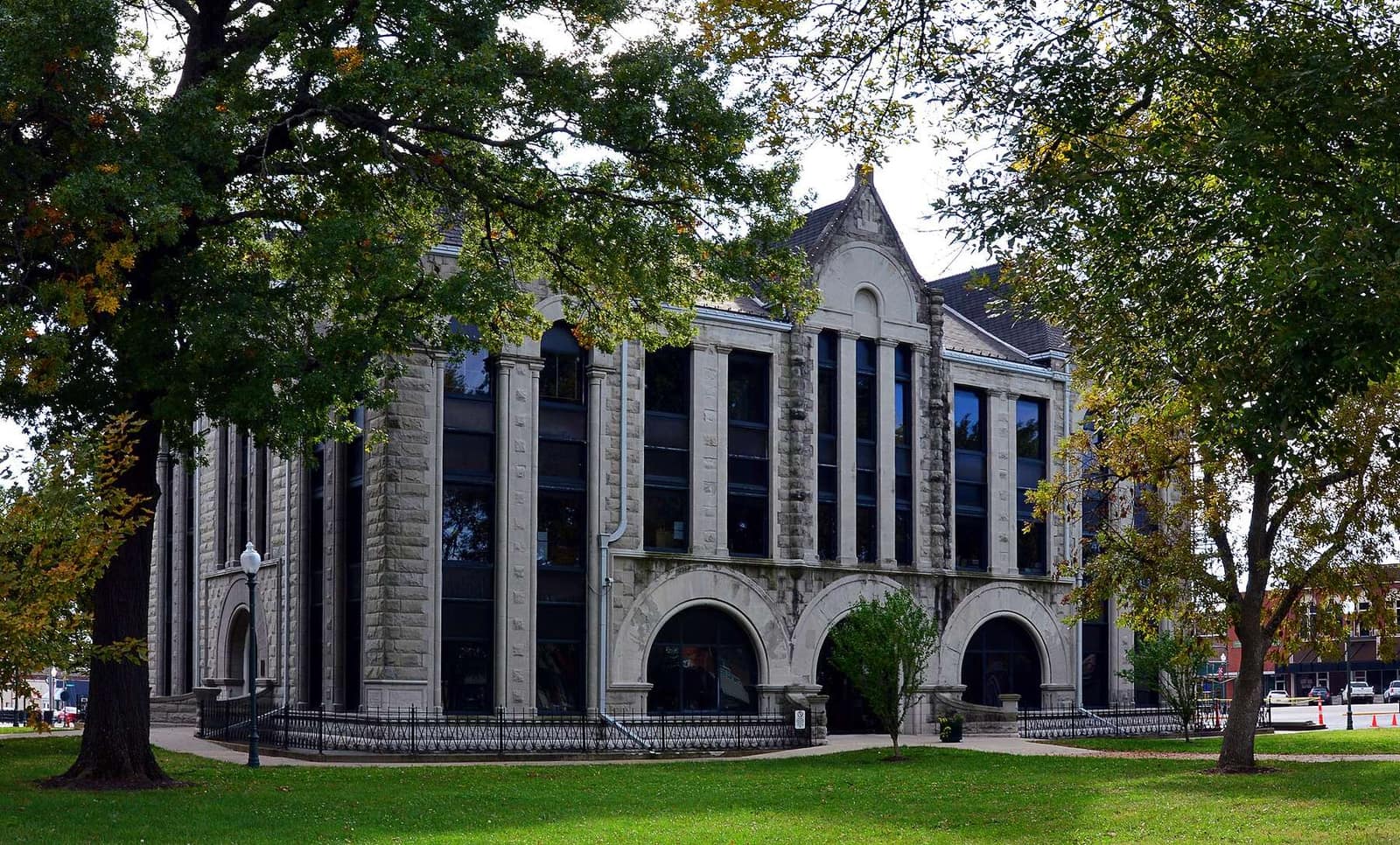
The header photo is of the Henry County courthouse in Clinton, Missouri — the building where the events of this report took place — from Wikimedia Commons, in the public domain. All other images in this report are public domain, licensed by America Counts, or produced by America Counts.

Licensing
This report is released under a Creative Commons Attribution-NonCommercial-ShareAlike 4.0 International license (CC BY-NC-SA 4.0). You may remix, adapt, and build upon this work non-commercially, provided you acknowledge America Counts and do not imply endorsement.
14. Detailed Results
The complete comparison — every value on the Fairview recount tape against the certified results:
| Contest | Choice | Tape | Official | Disposition |
|---|---|---|---|---|
| State Auditor (Rep) | Scott Fitzpatrick | 120 | 120 | Exact match |
| State Auditor (Rep) | Gerald (Jerry) Wistrand Jr. | 17 | 17 | Exact match |
| US Representative Dist. 4 (Rep) | Mark Alford | 103 | 103 | Exact match |
| US Representative Dist. 4 (Rep) | Heather Shelton | 27 | 27 | Exact match |
| US Representative Dist. 4 (Rep) | Scott Vincent Vera | 10 | 10 | Exact match |
| State Senator Dist. 28 (Rep) | Sam Alexander | 74 | 74 | Exact match |
| State Senator Dist. 28 (Rep) | Brad Pollitt | 40 | 40 | Exact match |
| State Senator Dist. 28 (Rep) | Chuck Lentz | 28 | 28 | Exact match |
| State Representative Dist. 126 (Rep) | Jim Kalberloh | 128 | 128 | Exact match |
| Associate Circuit Judge (Rep) | Harold L. Dump | 123 | 123 | Exact match |
| Presiding Commissioner (Rep) | Michael Rosiere | 66 | 66 | Exact match |
| Presiding Commissioner (Rep) | Daniel P. Wilson | 51 | 51 | Exact match |
| Presiding Commissioner (Rep) | Miles Wirsig | 30 | 30 | Exact match |
| County Clerk (Rep) | Kelly Marriott | 127 | 126 | Explained match (marginal-mark re-read; §7) |
| Circuit Clerk (Rep) | Wendi McGhee | 124 | 124 | Exact match |
| Recorder of Deeds (Rep) | Gail A. Perrymann | 123 | 123 | Exact match |
| State Auditor (Dem) | Quentin Wilson | 18 | 18 | Exact match |
| State Auditor (Dem) | Gregory Upchurch | 9 | 9 | Exact match |
| US Representative Dist. 4 (Dem) | Jordan Herrera | 3 | 3 | Exact match |
| US Representative Dist. 4 (Dem) | Wayne Russell | 2 | 2 | Exact match |
| US Representative Dist. 4 (Dem) | Hartzell Gray III | 0 | 0 | Exact match |
| US Representative Dist. 4 (Dem) | G Rick | 0 | 0 | Exact match |
| US Representative Dist. 4 (Dem) | Jeanette Cass | 6 | 6 | Exact match |
| US Representative Dist. 4 (Dem) | Ashleigh Rogers | 9 | 9 | Exact match |
| US Representative Dist. 4 (Dem) | Randy Miller | 7 | 7 | Exact match |
| State Senator Dist. 28 (Dem) | Mike McCaffree | 25 | 25 | Exact match |
| State Representative Dist. 126 (Dem) | Melissa Perry | 24 | 24 | Exact match |
| Presiding Commissioner (Dem) | Shannon Hills | 24 | 24 | Exact match |
| Prosecuting Attorney (Dem) | Fred R. Bunch | 24 | 24 | Exact match |
| State Auditor (Lib) | Dustin Coffell | 3 | 3 | Exact match |
| US Representative Dist. 4 (Lib) | Thomas Holbrook | 2 | 2 | Exact match |
| Fairview Township Committeeman (Rep) | Chris Wirsig | 105 | 105 | Exact match |
| Fairview Township Committeeman (Rep) | David Scott Bayless | 37 | 37 | Exact match |
| Constitutional Amendment No. 1 | Yes | 144 | 144 | Exact match |
| Constitutional Amendment No. 1 | No | 41 | 41 | Exact match |
| Constitutional Amendment No. 2 | Yes | 146 | 146 | Exact match |
| Constitutional Amendment No. 2 | No | 38 | 38 | Exact match |
| Constitutional Amendment No. 4 | Yes | 44 | 44 | Exact match |
| Constitutional Amendment No. 4 | No | 143 | 143 | Exact match |
| Constitutional Amendment No. 5 | Yes | 29 | 29 | Exact match |
| Constitutional Amendment No. 5 | No | 158 | 158 | Exact match |
Both documents agree the precinct cast 188 ballots (10 non-partisan, 147 Republican, 28 Democratic, 3 Libertarian). The one difference is absorbed by the County Clerk race’s undervote line (tape 127 votes + 20 undervotes = 147 Republican ballots; official 126 + 21 = 147).
Sample comparisons
Sample comparisons
Nothing here has to be taken on trust. Both sides of every comparison in this analysis are public: the county's released tape scans (reproduced on the sample page) on one side, the certified results published on Henry County's website on the other. Anyone can open both and check this work themselves.

But doing that is laborious and dull, and it takes a bit of practice to know where to look. So we do some of it for you here. These sample comparisons show concretely what happens under the hood in an Actual Vote analysis — how one line of printed paper becomes one value, and how that value is matched to the figure Henry County certified — and they let someone who is never going to re-run the whole analysis still check a piece of it with their own eyes, as evidence that our conclusions hold.
The 10 are chosen mechanically, by a fixed stride or a seeded draw through the sorted results rather than by hand, so the selection cannot be arranged to flatter the outcome — and they are a representative mix of how values are read: most by AI transcription, and, where this analysis needed it, values a person read from the source because the machine declined to guess or the paper carried something the printed tally did not. Here is one of them, carrying the number it has on that page:
This one is the specimen for a reason: it is from the Presiding Commissioner race — the contest whose 236-vote margin prompted this whole analysis — and, like every value in this analysis, it was read by a person from the county’s released scans rather than by AI transcription, which is why the provenance line says so.
What the poll tape printed
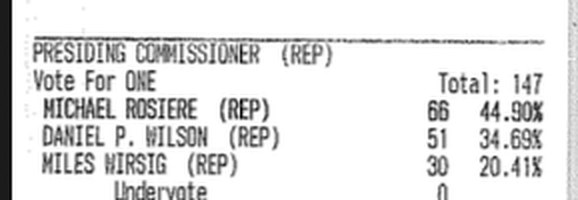
Miles Wirsig — 30 (read by a person from the county's scans)
Official certified result
MILES WIRSIG — 30
Source & location
Election Results 8-4-2026 Official.pdf
Statement of Votes Cast p.6/54 → PRESIDING COMMISSIONER (REPUBLICAN PARTY) → FAIRVIEW → Normal = 30 15. Version History
| Version | Date | Change |
|---|---|---|
| v1.0 | September 14, 2026 | First published, as an ongoing analysis. Fairview comparison: 41 comparisons, 2,231 votes audited, 40 exact matches, 1 explained match, 0 apparent discrepancies. Records question pending before the Missouri Attorney General. |